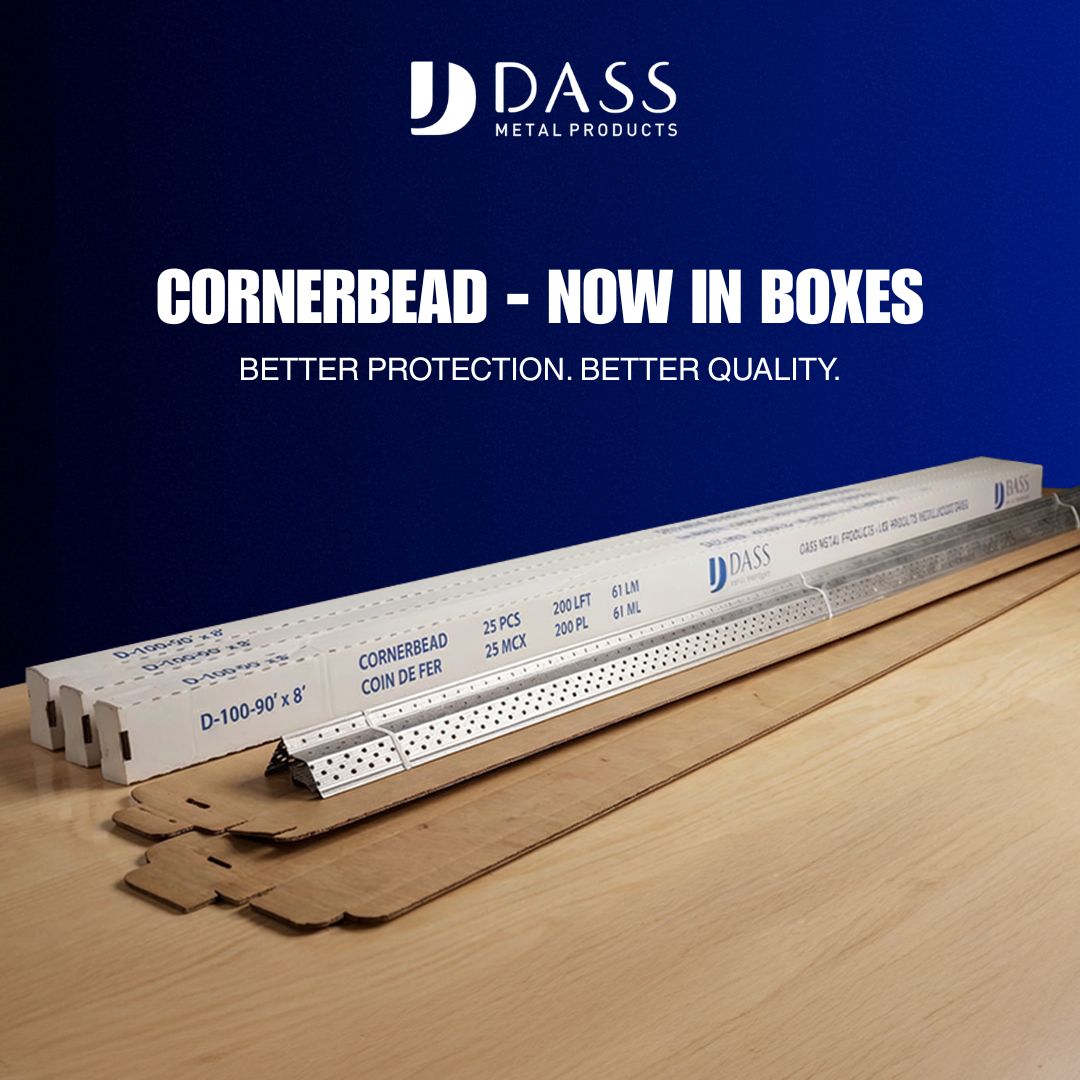
The right drywall corner bead depends on more than whether you prefer metal or vinyl. Cornerbead selection should account for the corner angle, board thickness, impact exposure, moisture conditions, finish expectations, lighting, and the fastening method available on site.
A bead that suits a standard, low-traffic partition may be a poor fit for a busy corridor, sharply lit wall, damp area, or unusual corner geometry. The most reliable approach is to select the profile and material together, then confirm that the bead matches the framing, board edge, finishing process, and project documentation.
Quick summary

- Confirm whether the corner is a standard 90° corner, a 130° corner, a bullnose design, or another edge condition.
- Assess traffic, likely impact, moisture exposure, lighting, and the desired appearance before choosing the material.
- Check board thickness, alignment, framing compatibility, and the bead’s fastening and finishing requirements.
- Do not choose solely on initial price. Confirm product documentation and applicable project specifications before ordering.
Start With Project Conditions, Not the Bead Material
Corner bead selection is a project-fit decision. Consider how much contact the corner will receive, whether moisture is present, how visible imperfections may be under the lighting, and how easily the finished edge might need to be repaired.
Material choice and profile choice are separate decisions. Metal, paper-faced metal, vinyl, and expanded metal describe different material or construction approaches, while 90°, 130°, bullnose, and other shapes describe the corner geometry or finished appearance. Selecting the right material in the wrong profile can still produce poor alignment, excess compound, or an appearance that does not match the design.
Drywall Corner Bead Types Compared

The following comparison provides a starting point, not a universal ranking. Actual suitability depends on the product specification, substrate, installation method, and conditions at the corner.
| Type or profile | Useful selection considerations | Questions to confirm |
|---|---|---|
| Paper-faced metal | Combines a metal core with a paper face designed to integrate with the finishing process. It may suit projects where a consistent finished transition is important. | Does the facing suit the specified compound and finishing method? Is the underlying corner straight and adequately supported? |
| Expanded metal | Provides a perforated metal format that may suit an installation and finishing process designed for that construction. | How will it be fastened, covered, and finished? Does product documentation address the intended substrate? |
| Vinyl | May be appropriate where a non-metal bead and the specified finishing approach suit the project conditions. | Will the material suit the exposure, temperature, moisture conditions, and required finish? What attachment method is specified? |
| Standard metal | May be appropriate where a rigid metal edge is required and the product’s material and finish suit the environment. | Is the coating suitable for the application? How will the bead be aligned and secured without visible irregularities? |
| Bullnose | Creates a rounded outside-corner appearance rather than a conventional sharp corner. It is primarily a design and profile decision. | Does the profile match the adjacent trim, board arrangement, and design intent? Can the crew maintain the intended radius? |
| 130° profile | Can suit an obtuse outside corner where a standard 90° bead would not follow the geometry correctly. | Has the actual angle been measured or confirmed from the drawings? Does the profile match the board edges and finishing plan? |
Choose the Profile That Matches the Corner Geometry
A standard 90° corner is only one possible condition. If framing creates an obtuse angle, a 130° corner bead may be more appropriate than forcing a conventional profile into place. For rounded or design-focused corners, a bullnose profile changes both the appearance and the finishing technique.
Measure the physical corner and compare it with the drawings before ordering. Check whether the drywall edges meet evenly and whether the underlying framing allows the bead to sit straight. A profile that is close to the intended angle can still require excessive compound or patching if the board edges are inconsistent.
Lighting deserves attention at this stage. Strong light across a wall can reveal waviness, uneven feathering, or a corner line that is not aligned. The chosen profile should support the required finish appearance, not simply cover the edge.
Match the Bead to Impact, Moisture, Lighting, and Design Intent
High-traffic locations such as corridors, entrances, and busy commercial interiors deserve a closer review of edge protection and repair expectations. Do not assume every metal bead, or every vinyl bead, will perform identically. Confirm the relevant product information for the expected exposure and use.
Moisture is another reason to avoid selecting by habit. Areas exposed to damp conditions, cleaning, or changing humidity may require a material and finishing system suited to those conditions. The correct decision depends on the complete assembly and product documentation.
For a design-focused interior, the profile may be as important as the material. Bullnose corners soften the visual line, while a 130° bead follows an obtuse geometry. In a standard interior, the priority may instead be a clean, straight edge that integrates efficiently with the planned taping and finishing process.
Confirm Board Thickness, Edge Conditions, and Framing Compatibility
Board thickness and edge condition affect how the bead sits on the corner. A mismatch can leave the bead proud of the board, create a hollow area that needs extra compound, or make the finished line difficult to maintain. Confirm the board thickness on each relevant wall assembly rather than relying on a typical detail.
Review the framing behind the board as well. A corner bead cannot correct a corner that is substantially out of alignment or poorly supported. The framing, board installation, bead profile, and finishing layers need to work as one system.
Matching trims and cornerbeads to board thicknesses and edge conditions can reduce patching. Apply the same principle to adjacent L trim, J trim, or other drywall finishing sections where the corner transitions into another surface.
Review Fastening and Finishing Requirements Before Ordering
Selection should include the installation sequence: measure, cut, align, fasten, tape or embed where specified, and finish. The bead must suit the method the crew is expected to use and the substrate available at the corner.
For metal bead, fastening may pass through pre-punched holes or directly through the metal when necessary, depending on the product and installation requirements. That does not mean every method is suitable for every bead. Confirm the manufacturer’s instructions, compatible compound or adhesive where applicable, and required attachment details before work begins.
Dry-fit or verify a representative corner before ordering large quantities when the geometry, finish, or installation method is unusual. This can reveal alignment problems early, when changing the profile is easier than correcting finished walls.
Common Corner Bead Selection Mistakes
Choosing only by the lowest upfront cost
A lower purchase price may be offset by extra compound, slower finishing, visible defects, or more difficult repairs. Compare the complete installation and maintenance implications, not just the unit price.
Ignoring the angle and board thickness
A standard 90° bead will not automatically suit an obtuse corner, and a profile that does not match the board thickness can create unnecessary patching. Confirm both measurements before specifying the product.
Overlooking lighting and design intent
A straight, sharp corner and a rounded bullnose corner create different visual results. Consider how light will fall across the wall and whether the design calls for a conventional edge or a softer profile.
Failing to plan fastening and finishing
A bead may be suitable in theory but impractical for the available installation process. Confirm alignment, attachment, taping, compound, and finishing requirements before the material arrives on site.
Assuming code or a generic specification settles every detail
Building-code requirements and project specifications should be checked for the particular assembly and location. Where Ontario requirements apply, review the current provisions through Ontario’s Building Code and compare them with the drawings, specifications, and product documentation.
Pre-Order Corner Bead Selection Checklist
Use this checklist before requesting pricing, releasing a purchase order, or beginning installation:
- Corner geometry: Is the corner 90°, 130°, bullnose, curved, or another angle?
- Material: Is metal, paper-faced metal, expanded metal, or vinyl appropriate for the exposure and finishing process?
- Board compatibility: What board thicknesses and edge conditions must the bead accommodate?
- Exposure: Is the corner in a high-traffic area or likely to receive repeated contact?
- Moisture: Could humidity, cleaning, or damp conditions affect the material or finish?
- Appearance: Does the project require a sharp, rounded, obtuse, or distinctive finished edge?
- Lighting: Will direct or raking light make alignment and finishing defects especially visible?
- Installation: What measuring, cutting, alignment, fastening, taping, and finishing methods will be used?
- Documentation: Are product data, installation instructions, and required compliance documents available?
- Requirements: Have the drawings, specifications, applicable code provisions, quantities, and repair expectations been reviewed?
Frequently Asked Questions
Is metal or vinyl corner bead better for drywall?
Neither is universally better. The choice depends on corner exposure, moisture conditions, board compatibility, required appearance, fastening method, and product documentation. Compare the complete finishing system rather than selecting from the material name alone.
When is paper-faced metal corner bead a suitable choice?
Paper-faced metal may suit a project where a metal-supported edge and integrated paper-facing finish are compatible with the specified compound and finishing process. Confirm the substrate, alignment, facing, and installation instructions before ordering.
What is a 130° corner bead used for?
A 130° corner bead is intended for an obtuse outside corner rather than a conventional 90° corner. Verify the actual angle and board arrangement first, because an incorrect profile can lead to poor alignment and additional patching.
Should corner bead selection be checked against the building code or project specifications?
Yes. The bead is only one part of the finished wall assembly. Review the project drawings, specifications, manufacturer’s documentation, and applicable code provisions. In Ontario, Regulation 163/24 incorporates the National Building Code of Canada 2020 with Ontario amendments, so project teams should confirm which current requirements apply through Ontario Regulation 163/24.
Conclusion
Good cornerbead selection starts with actual project conditions. Confirm the corner geometry, then match the material and profile to impact exposure, moisture, lighting, design intent, board thickness, framing alignment, fastening method, and finishing process. This approach is more reliable than choosing a familiar bead or the lowest initial price.
Before ordering, check the product documentation and project requirements, and resolve unusual angles or edge conditions before installation begins. Dass Metal Products is a Vaughan, Ontario manufacturer and supplier of drywall finishing trims, including cornerbead, as well as steel studs and metal framing systems. Visit Dass Metal Products to review available product information and discuss project requirements.