Steel track buyer guide
Short answer: buy from the approved project documents, not the word “track.” Confirm whether the member is standard, deep-leg, slotted-deflection, structural or specialty track; match stud depth and required leg geometry; verify design thickness, material and coating; coordinate movement, attachments and openings; then require current product data, marking, quantity, lengths, fabrication and delivery terms.
Technical boundary: this buyer guide does not design an assembly, select a member, provide a load rating, approve a substitution or establish code compliance. The registered design professional, project specifications, approved assemblies, applicable code and authority control. Dass product pages checked July 17, 2026 require direct confirmation for current specifications and availability. No certification or performance claim is made here.
Start with the track’s role in the approved assembly
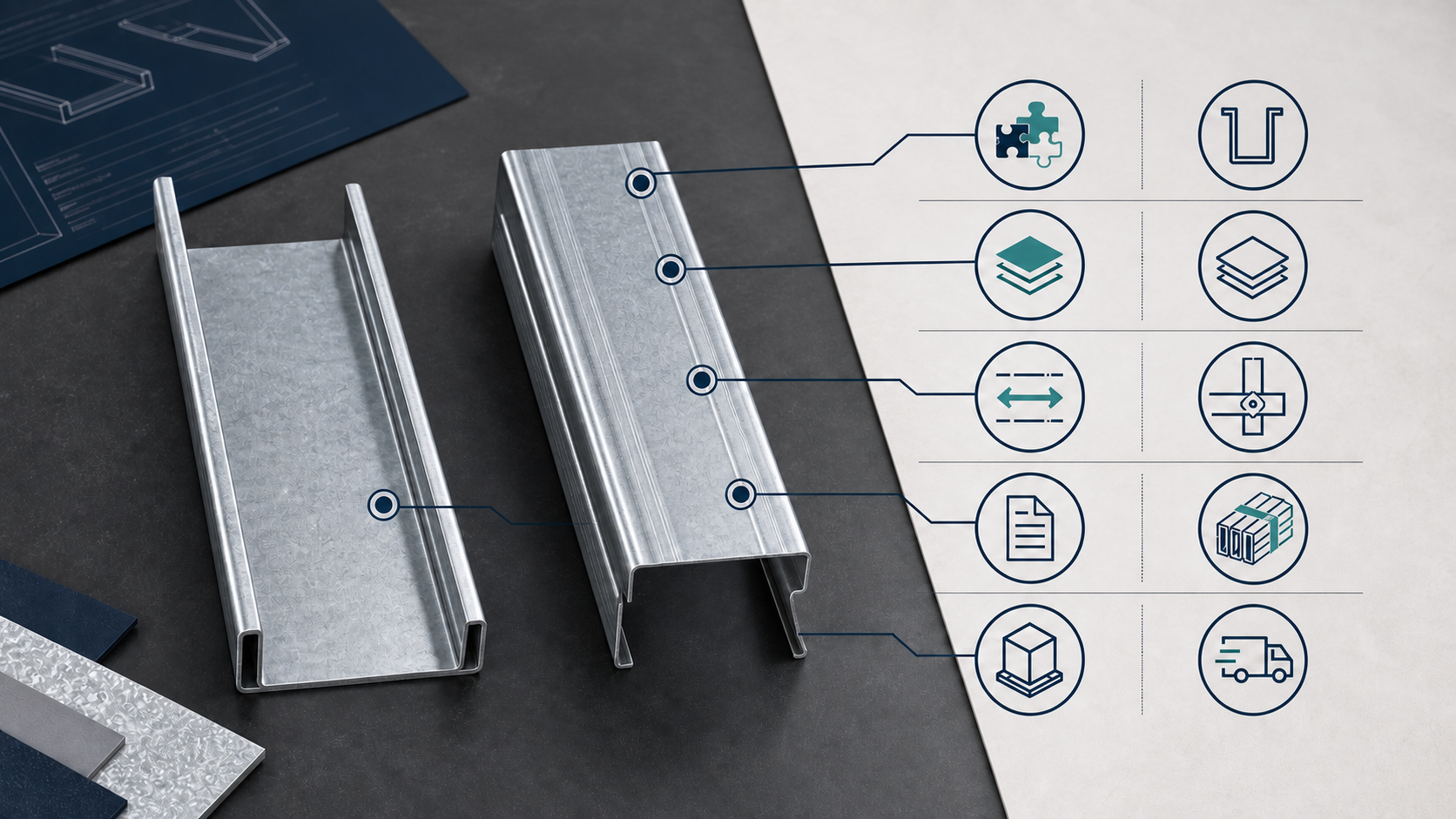
Cold-formed steel track can serve as a floor or head runner, boundary member, opening component, distribution member or part of a proprietary movement detail. Products that look similar can have different leg depth, thickness, slots, material, coating, geometry and design responsibility. “Standard track” does not automatically fit every wall.
Dass Metal Products publishes a Standard Track Products page and separately lists deep track, slotted deflection track and U-flex track. That separation is a useful buying prompt, not permission to interchange them. Confirm the exact detail and schedule before requesting a quote.
The Canadian Sheet Steel Building Institute’s guide specification for non-loadbearing steel framing treats framing as a specified system with standards, submittals and project-specific amendments. The CSSBI member-selection material also uses distinct product designators for track and furring sections. Use the full designation from the documents rather than a jobsite nickname.
Use ten selection criteria for every steel track line item
| Criterion | Buying question | Risk if omitted |
|---|---|---|
| Assembly and location | Which wall, ceiling, opening, shaft, exterior or other detail uses this track? | A nominally similar product may serve a different system. |
| Track type | Standard, deep-leg, slotted, structural, flexible or specialty? | Movement, bearing, attachment or geometry may be wrong. |
| Stud compatibility | Which stud depth, flange and thickness must engage the track? | Fit, screw placement and restraint can be compromised. |
| Geometry | What web, leg, return, slot, hole or custom-profile dimensions are required? | Nominal width alone does not define the section. |
| Design thickness | What specified design or minimum base-metal thickness and tolerance apply? | Gauge words can be ambiguous across suppliers. |
| Material and coating | Which steel grade and protective coating are specified for the exposure? | Durability and design assumptions can change. |
| Movement detail | Must the head, slab or adjacent system move independently? | A fixed standard-track connection may conflict with the detail. |
| Connections | Which fasteners, clips, anchors, spacing and edge distances are designed? | The member cannot be separated from its connections. |
| Assembly performance | Is the product part of a fire, acoustic, structural, thermal or other tested or listed assembly? | Unreviewed substitution can invalidate the assembly. |
| Documentation | What product data, markings, test or evaluation evidence and submittal approval are required? | Received material may not be traceable to the approved item. |
Do not convert a specified thickness into a gauge from memory. CFSEI’s current technical-note catalogue distinguishes structural and nonstructural framing and lists guidance on standards, connections, deflection track and nonstructural member design. A qualified designer should resolve ambiguity before purchase.
Require a submittal package that can be checked
- Project reference: drawing, detail, wall type, schedule, specification section and revision.
- Product identity: manufacturer, product name, section designation and intended assembly role.
- Geometry: dimensioned profile and tolerances appropriate to the requirement.
- Material: specified steel, design thickness and coating information.
- Performance evidence: only the load, test, listing or evaluation data required for the exact application.
- Connections: compatible studs, fasteners, clips, anchors and movement detail.
- Identification: product marking, bundle tags, traceability and documentation at delivery.
- Substitution record: written comparison and design-professional acceptance before purchase where required.
Dass links a resource area and load-table materials from its site. Treat any table as applicable only to the named product, edition, units, boundary conditions and notes. This article does not adopt or restate a Dass load, certification, code or assembly claim.
If a project uses a listed fire or acoustic system, confirm that the proposed product and installation match the current listing and approved documents. Similar shape or material is not evidence of equivalence.
Plan quantity, fabrication and delivery around the drawings
A purchase order should identify each track type separately. Grouping standard, deep, slotted and specialty pieces under one description invites receiving errors. State length, quantity, custom cuts, slots or punches, bundle organization, labels and delivery sequence. Confirm whether custom work changes lead time, minimum quantity, returnability or approval requirements.
Use takeoff rules that match the assembly: floor and head runs, openings, intersections, splices, curves, waste, damaged-material allowance and phased delivery. Do not apply one waste percentage blindly. Reconcile takeoff totals with wall types and revisions before release.
Coordinate storage and handling. Ask how bundles must be supported, protected and identified; how damaged, wet, deformed or unmarked material will be quarantined; and who approves replacement. A low unit price loses value if the wrong designation reaches the wrong floor or phase.
Ask Dass Metal these decision-ready questions
Dass’s current product page lists multiple nominal widths, one standard leg dimension, several gauge labels, a standard length and custom-length availability, then tells buyers to contact the company for current information. Because project requirements vary and the user asked us not to publish unverified specifications, this guide does not repeat those figures as an order recommendation.
- Can you quote the complete product designator and dimensioned section shown in our approved documents?
- Is the line item standard, deep, slotted, structural or another track type?
- What current product data and material documentation accompany it?
- How is design thickness shown, and how does it map to any gauge label used?
- Which stud product and assembly is it intended to match?
- Are lengths, slots, punches, labels or bundles standard or custom?
- What is excluded from the quote—fasteners, clips, engineering, freight, unloading or taxes?
- What lead time, minimum, return and change terms apply to this exact line?
- How will bundle tags and product markings identify the approved designation?
- Who should receive a technical substitution request before ordering?
Stop and resolve these steel track red flags
- The quote says only “track” and a nominal width.
- Gauge is given without design thickness or product data.
- Standard track is proposed where the detail shows movement or another profile.
- The stud and track geometry or thickness basis do not match the approved schedule.
- A supplier claims code, fire, acoustic or structural equivalence without project-specific evidence.
- Custom cuts, slots, punches or lengths are released before submittal approval.
- Load-table values are copied without notes, units, edition and boundary conditions.
- Bundles arrive unmarked or cannot be traced to the purchase-order line.
- Price excludes freight, minimums, fabrication, clips or other required components without notice.
Common steel track buying mistakes to avoid
Do not buy by visual similarity, rely on a field nickname or allow a purchasing system to collapse distinct track types. Do not assume a thicker-looking member is an approved upgrade; geometry, connection, material and assembly evidence also matter. Do not let price comparison begin until each supplier has the same designation, quantity, lengths, fabrication and delivery scope.
Do not order around an unresolved RFI or assume a salesperson can make the designer’s substitution decision. Record the final approval, drawing revision and product data with the purchase order. At delivery, compare markings and bundle tags with that record before installation.
Frequently asked questions
Is all steel track interchangeable if the nominal width matches?
No. Type, geometry, thickness, material, coating, movement, connection and assembly requirements can differ.
Can gauge alone define the track?
No. Use the specified design thickness and full product designation because gauge terminology can be ambiguous.
When is standard track not the right option?
When approved documents require another role or detail, such as movement, different leg geometry, structural performance, curves or a specialty assembly.
Does Dass certify that a selected track meets my project?
No such conclusion is made here. Request current product data and have the responsible project professionals review it.
Send a complete track schedule for quotation
Use Dass Metal Products’ contact form with the approved track schedule, drawings, full designations, quantities, lengths, fabrication and delivery requirements. Final technical, certification, compliance, availability, price and advertising review are required before publication.