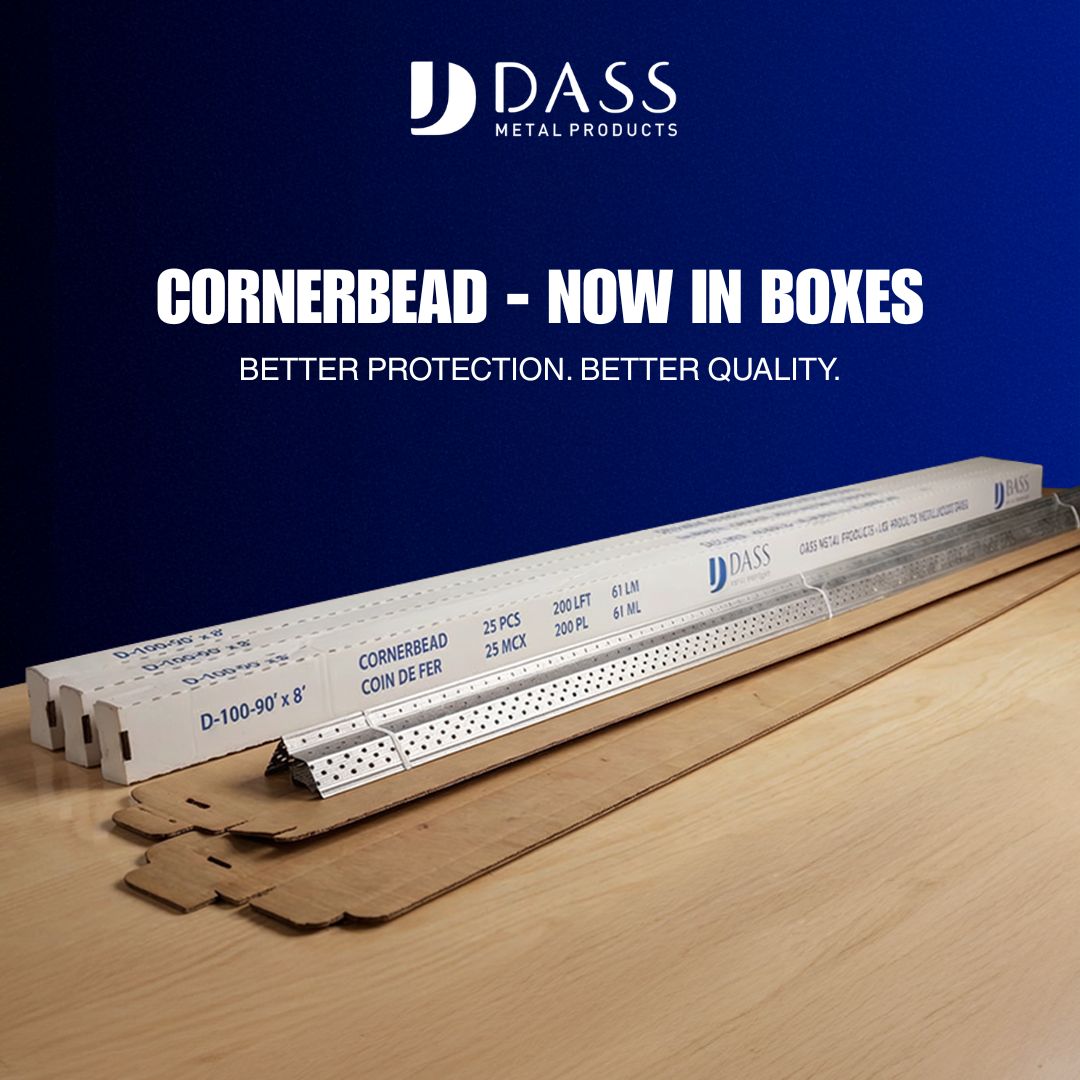
Framing corners with metal studs is building rigid, plumb intersections where two steel-stud walls meet so drywall lands cleanly and stays crack-free. It uses the right track, stud gauges, backing, and bridging to control twist and movement. At 370 New Enterprise Way in Vaughan, Dass Metal Products supports this with engineered studs, tracks, channels, and clips designed for repeatable, code-ready results.
By Navjot Dass — Dass Metal Products
Last updated: 2026-05-02
At a Glance
To frame durable metal-stud corners fast: select the correct track (standard, deep, or slotted), build a two- or three-stud corner with continuous backing, and add bridging within 24–48 inches of the intersection. Keep screw spacing 12–16 inches on-center and hold a 1/2–3/4 inch head gap where deflection is required.
- What you’ll learn: proven corner assemblies, when to use deep or slotted track, and the exact steps to keep corners straight on tall partitions.
- Who it’s for: commercial drywall/framing teams, GCs, and specifiers who want cleaner finishes and fewer callbacks.
- Why it matters: better corners cut rework, speed inspections, and improve acoustics at room boundaries.
- Use cases: tenant improvements, healthcare suites, schools, retail fit-outs, and corridor returns 10–14 feet high.
Table of Contents
This guide covers definitions, why metal-stud corners matter, how they work, common assemblies, a step-by-step build, best practices, tools, case examples, local tips, and FAQs. Use the anchors to jump to the section you need.
- What is framing corners with metal studs?
- Why corner framing matters
- How metal-stud corners work
- Types and approaches
- Corner comparison table
- Step-by-step process
- Best practices
- Tools and resources
- Case studies and examples
- Frequently Asked Questions
- Conclusion and next steps
What is framing corners with metal studs?
Framing corners with metal studs is assembling light gauge steel studs and tracks to create 90° or off-angle intersections that are plumb, rigid, and backed so drywall edges fasten securely. The build controls racking and twist with bridging and, when required, isolates head movement using slotted deflection track.
In the field, you combine the correct stud gauge (25–20 ga typical for non-load-bearing) with compatible track depth, then add backing so both sheets have bite. Drywall fastener lines usually run 12–16 inches on-center, with 3/8 inch minimum edge distance to avoid tear-outs. Where slabs or roof decks move, a 1/2–3/4 inch slip gap at the head protects corner bead from seasonal deflection.
Because corners concentrate forces, even small errors multiply. A flange rolled 1/8 inch or a missed bridging channel can show up later as a wavy corner or cracked 90°/130° cornerbead. That’s why our teams emphasize layout accuracy, continuous backing, and early bridging within 24–48 inches of the intersection.
Why corner framing matters
Well-built steel-stud corners reduce finish cracks, speed board installation, and improve acoustic isolation. Crews gain minutes per corner when backing is present and flanges are co-planar, and projects see fewer callbacks where deflection details decouple the wall from moving slabs or decks.
- Finish quality: Plumb flanges and tight screw patterns keep corner bead tracking straight over 8–12 foot heights.
- Speed: Pre-cut U-channel or a third stud eliminates hunting for fastener paths; finishers coat 90° corners faster when edges align.
- Acoustics: At room boundaries, resilient channel plus well-backed corners limit sound flanking. A single hard-fastened corner can short-circuit isolation.
- Compliance: Tested fire/sound assemblies often mandate slip head-of-wall details; a 1/2–3/4 inch head gap maintains ratings while protecting finishes.
In our experience supporting teams from Ontario to U.S. projects, the difference between a crisp 90° corner and a problematic one is rarely “luck.” It’s repeatable choices: correct track, early bridging, and continuous backing. Those choices cut rework windows on fast-track schedules by measurable hours per floor.
How metal-stud corners work
Corners work by aligning base and head tracks, fastening studs to control axial/lateral loads, and installing bridging to stop flange roll. Drywall edges land on stud flanges or added channels. Slotted deflection tracks let studs float so building movement doesn’t crack the corner finish.
Mechanically, the base track sets the footprint; the head track sets the upper plane. Studs seat into both and are stitched with #8 self-drilling screws. Bridging/carrying channel resists torsion so flanges remain co-planar while sheets go up. On tall runs (10–14 feet), deep track at the head/base increases bearing, making alignment faster and more forgiving by a clear margin.
When head movement is expected, slotted deflection track and compatible clips decouple the wall. Drywall attaches to the studs only—not the head. The 1/2–3/4 inch slip gap is later sealed per the tested assembly. This small detail often prevents hairline cracks that show up 30–90 days after turnover.
Types and approaches
Use a two-stud L corner with added backing for most partitions, a three-stud box where traffic or fixtures demand rigidity, deep track for tall walls, and slotted deflection track wherever slabs or decks move. For shaftwall enclosures, use CH studs with J-track per system details.
Two-stud L corner (with backing)
- When to use: Standard non-load-bearing partitions 8–12 ft high.
- Build: One stud turns to form the L; add 1-5/8 in. U-channel or flat strap so both sheets have bite.
- Fasteners: #8 self-drillers at 12–16 in. o.c.; keep 3/8 in. edge distance.
Three-stud “box” corner
- When to use: High-traffic zones, heavy millwork anchorage, or abuse-resistant boards.
- Build: Two studs meet; a third stud creates a box for continuous screw surfaces.
- Notes: Strap ties stop separation; bridge within 24–48 in. of the corner.
Deep-track backed corner
- When to use: Tall partitions (10–14 ft) or where slab tolerance makes alignment tricky.
- Build: Use deep track (increased leg depth versus stud) at base/head; tie studs with clips/screws.
- Benefit: More bearing and visual control; reduces racking during boarding.
Slip/deflection corner
- When to use: Where floors/roofs deflect under live load or temperature.
- Build: Slotted deflection track at the head; drywall only to studs. Hold 1/2–3/4 in. head gap.
- Finish: Seal/slip per tested assembly to maintain ratings.
Shaftwall/CH stud corner
- When to use: Elevator/stair shafts and rated enclosures.
- Build: CH studs with J-tracks; verify stud engagement and track seating depth.
- Tip: Pre-cut liner panels; plumb/lock before closing.
For acoustic boundaries, pair resilient channel with solidly backed corners so fastener paths don’t short-circuit isolation. Where heavy casework returns at corners, three-stud boxes or special profiles prevent flexing and punctured finishes over time.
Corner comparison table
Choose corners by height, abuse, and movement. Two-stud L corners fit standard walls. Three-stud boxes add rigidity for traffic and fixtures. Deep track helps on tall runs. Slotted head track protects finishes where slabs move. Shaftwall corners use CH studs and J-tracks for rated shafts.
| Corner Type | Typical Use | Backing | Pros | Watch-outs |
|---|---|---|---|---|
| Two-stud L | Most 8–12 ft partitions | U-channel or flat strap | Fast, material-efficient | Needs bridging within 24–48 in. |
| Three-stud box | High-traffic, millwork | Continuous stud surfaces | Very rigid, easy fastening | More material/time |
| Deep-track backed | Tall runs, poor slabs | Stud + deep track | Alignment control | Confirm track compatibility |
| Slip/deflection | Movement at head | Stud-only drywall | Protects finishes | Respect 1/2–3/4 in. gap |
| Shaftwall CH/J | Rated shafts | System-specific | Code-tested | Follow system details |
Step-by-step process
Lay out both legs, anchor base track, install head track (use slotted for deflection), stand and plumb the first stud, add the return stud, install continuous backing, then bridge within 24–48 inches. Verify screw patterns and leave head gaps before drywall and bead.
- Confirm specs: Review drawings for gauge (25–20 ga typical NLB), heights (8–14 ft), and slip requirements (1/2–3/4 in.).
- Snap lines: Chalk both legs; verify 90° or required angle with a square or laser.
- Anchor base track: Approved anchors per substrate; keep within tolerance so returns align.
- Install head track: Use slotted deflection track where movement is expected; don’t fasten board to slotted heads.
- Stand first stud: Plumb and stitch into base track with #8 screws; check co-planarity.
- Add return stud: Form the L; clamp, square, and fasten flanges together at 12–16 in. o.c.
- Provide backing: Add 1-5/8 in. U-channel, flat strap, or a third stud for continuous screw landing.
- Bridge early: Install bridging/carrying channel within 24–48 in. of the corner; continue at 4–6 ft intervals.
- QC before board: Verify plumb, screw spacing, and flange alignment; correct before hanging.
- Drywall and bead: Attach board to studs/backing (not slotted head). Install 90° or 130° cornerbead straight and true.

Best practices for metal-stud corners
Use precise layout, match track to conditions, add continuous backing, and lock corners with bridging. Keep #8 screw patterns consistent, maintain at least 3/8 inch edge distance, and verify plumb/co-planarity before boarding so corner bead tracks straight over 8–12 foot heights.
- Layout accuracy: A 1/8 in. layout error compounds at the corner; lasers help hold 90° over 20–30 ft runs.
- Track selection: Standard for typical heights, deep for tall runs, slotted for movement; confirm compatibility with stud flange width.
- Back both sheets: Corners need two good landing zones; U-channel or third stud solves wandering fastener lines.
- Bridge within 24–48 in.: Early bridging limits flange roll while sheets go up; continue at 4–6 ft spacing to the ceiling.
- Respect slip gaps: Hold 1/2–3/4 in. at head-of-wall; don’t pin board to slotted heads.
- QA photos: Snap plumb readings and screw patterns before board—saves time if questions arise at punch.
For more system-level guidance on controlling schedule risk, see our steel framing guide and our primer on interior wall framing mistakes that commonly show up at corners and returns.
Tools and resources
Bring a laser, 4-foot level, clamps, aviation snips, nibblers, impact drivers with #2 bits, and a screw gauge card. For design, use manufacturer load tables, cold-formed steel standards, and tested fire/sound assemblies to verify gauges, spans, and slip details.
- Layout/measure: Laser, chalk, square, plumb bob for tall shots, 25–35 ft tapes.
- Cut/fit: Aviation snips, chop saw with metal blade (where allowed), nibblers for clean cuts on 20 ga.
- Fasten: #8 and #10 self-drilling screws, stitch screws, appropriate anchors to concrete or steel.
- Brace: Bridging/carrying channel, strap ties, deflection clips per assembly notes.
- Design references: Manufacturer load tables and cold-formed standards; confirm slip head details in rated assemblies.
Coordinating with structure pays off. For example, sill anchors should respect reinforcement and embeds. See these references on reinforcement layout for context: foundation rebar details and rebar stirrups guidance. For fit-outs with built-ins at corners, review commercial millwork planning so backing aligns with casework fasteners.

Case studies and examples
On Ontario commercial interiors, pairing slotted head-of-wall track with three-stud box corners yields straighter finishes and fewer callbacks. Deep track at head/base simplifies alignment on 10–14 foot partitions, while early bridging within 24–48 inches keeps intersections square during boarding.
Retrofit corridor (12 ft returns)
- Challenge: Existing slab tolerances caused racking and wavy corners.
- Solution: Deep track at head/base, bridging within 24 in. of corners, and 1-5/8 in. U-channel backing.
- Result: Plumbed within 1/16 in. over 12 ft; finishers installed 90° bead in one pass.
Office build with meeting rooms
- Challenge: Sound bleed at intersecting corners and returns.
- Solution: Resilient channel on partitions, three-stud corners to avoid flex, and consistent 16 in. o.c. screw lines.
- Result: Noticeable STC improvement at boundaries; fewer nail pops reported 60 days after turnover.
Healthcare suite (rated head-of-wall)
- Challenge: Live-load deflection at the deck threatened finish cracks.
- Solution: Slotted deflection track with hold-down clips; drywall attached to studs only with a 3/4 in. slip gap.
- Result: No telegraphed cracking at 90 days; inspection sign-off on first visit.
For product selection that matches these scenarios, explore our cold-formed framing guide and our overview on when steel studs beat wood in commercial interiors.
Frequently Asked Questions
Build reliable corners by matching track to conditions, adding continuous backing so both sheets have bite, and installing bridging near the intersection. Maintain slip gaps at head-of-wall, and keep screw spacing consistent so corner bead tracks straight during finishing.
What corner assembly works best for most partitions?
A two-stud L with 1-5/8 inch U-channel or flat strap backing suits most non-load-bearing walls 8–12 feet high. It gives both board edges a secure landing and keeps screw paths obvious. Add bridging within 24–48 inches of the corner to limit flange roll.
When should I use slotted deflection track at a corner?
Use slotted deflection track whenever the structure above can move due to live loads or temperature changes. The slots let studs float so drywall isn’t pinned to the slab or deck. Hold a 1/2–3/4 inch head gap and avoid fastening board to the slotted head track.
How close should screws be at a metal-stud corner?
For framing, 12–16 inches on-center is typical with at least 3/8 inch edge distance. For drywall attachment, follow the board manufacturer and the tested assembly. Consistent patterns help corner bead sit flat and reduce touch-ups during finishing.
What keeps a corner from twisting during boarding?
Bridging or carrying channel within 24–48 inches of the corner limits flange roll and keeps the intersection square. Clamps during fastening help, and strap ties at three-stud boxes prevent separation when tall walls are boarded quickly.
Does resilient channel help at corners?
Yes—when corners sit on acoustic partitions, resilient channel reduces flanking paths. Pair RC with continuous corner backing and avoid rigid connections to the deck. Keep screw lines 16 inches on-center unless the tested assembly specifies otherwise.
Local considerations for 370 New Enterprise Way
- Seasonal swings can move slabs and roof decks. Use slotted head-of-wall details where partitions meet moving structure, and hold 1/2–3/4 inch slip gaps.
- Tight project timelines in the Vaughan area favor pre-cut U-channel and early bridging within 24 inches of corners to speed boarding sequences.
- Open office plans benefit from resilient channel near corner returns to reduce flanking; coordinate stud gauges (25–20 ga) with acoustic goals.
Need engineered backing or a special profile? Our team can help you match gauges, track types, and clips so your corners pass inspection the first time. See our overview on metal framing systems or review slotted deflection track essentials for movement joints.
Conclusion and next steps
The fastest path to straighter, tougher corners is consistent: accurate layout, the right track for conditions, continuous backing for both sheets, and early bridging. Where structures move, slotted deflection tracks protect finishes and reduce callbacks on 8–14 foot partitions.
- Key takeaways: Back both edges, bridge early (24–48 in.), keep 12–16 in. screw spacing, and respect 1/2–3/4 in. slip gaps.
- Next steps: Standardize two- and three-stud corner details; stock deep and slotted tracks for tall or moving conditions.
- Learn more: See our guides on using steel studs and selecting steel stud sizes for predictable layouts.
If you’re planning framing corners with metal studs on a fast schedule, our engineers at Dass Metal Products can help align gauges, tracks, and clips to your drawings—so your crew boards once and moves on.