Steel stud widths are the nominal web sizes of cold-formed C-shaped studs, most often spanning from 1-5/8 in. to 6 in. and beyond. Width steers wall capacity, routing space, and acoustic performance. Pick it first, then match gauge, track, and bracing. That’s how you avoid callbacks on both non-load-bearing and load-bearing work across Canada and the United States.
By Navjot Dass • Last updated: July 8, 2026 • In business since 1986
| Manufacturer | Dass Metal Products |
|---|---|
| Founded | 1986 |
| Service area | Canada and the United States (cross-border delivery) |
| Core capabilities | Interior/Exterior Framing, Drywall Finishing, Acoustic Products, Rebar & Welded Wire Mesh |
| Engineering support | 40+ years of cold-formed steel expertise |
| Certification | CSSBI-certified manufacturing |
| Business hours | Mon–Fri, 8:00 AM–5:00 PM |
Summary
Steel stud width is the web dimension that sets cavity depth and stiffness. Typical choices run 2-1/2 in. to 6 in., with 3-5/8 in. a common interior pick. Shift to 6 in.+ once heights increase, services stack up, or you need stricter deflection and acoustic control. Always coordinate gauge, track, and bracing.
You’re juggling wall schedules, MEP congestion, and height limits. We get it. As a Canadian manufacturer shipping since 1986, we’ve seen thousands of submittals. Below we share the rules of thumb our customers actually use on site—plus where we draw a hard line and ask you to upsize.
For deeper sizing context, bookmark our metal stud dimensions guide and the broader steel stud framing guide.
Steel Stud Width at a Glance: What the Numbers Actually Mean
The width on the label is the stud’s web size in inches (e.g., 3-5/8 in. = 3.625 in.). Wider webs boost section properties and routing space, but add depth. Real-world selection balances height, load, MEP needs, acoustic targets, and head-of-wall movement. Width is your first filter; gauge and bracing finish the job.
Three truths our team repeats daily:
- Width first, then gauge: You can’t fix a too-shallow cavity with thicker steel.
- Movement matters: If the structure moves and the head track can’t, drywall cracks. Slotted deflection track exists to prevent that failure.
- Bracing is not optional on tall fields: Bridging/carrying channel turns a wobbly forest of studs into a wall that behaves.
For non-structural partitions, our light-gauge stud guidance is the right starting point. For structural spans, review our heavy-gauge guidance and coordinate with your engineer.
Standard Steel Stud Widths and When to Use Each
Common widths: 1-5/8 in., 2-1/2 in., 3-5/8 in., 4 in., and 6 in.+. In our experience, 3-5/8 in. handles most interiors up to ~12 ft. Once you cross ~14–16 ft, route dense services, or chase higher STC, 6 in.+ becomes the safer, faster path to approval.
These field-tested ranges help you shortlist fast. They’re rules of thumb for non-load-bearing work; always verify final spans and deflection with project documents.
| Nominal width | Typical gauge range | Approx. max unsupported height (non-structural) | Best-fit use | Dass pairing |
|---|---|---|---|---|
| 1-5/8 in. | 25–20 ga | ~8–10 ft (with bracing) | Tight, low-traffic partitions | Standard track; minimal bridging |
| 2-1/2 in. | 25–20 ga | ~9–11 ft | Light interior partitions | Standard track; selective bridging |
| 3-5/8 in. | 25–20 ga (occasionally 18 ga) | ~10–12 ft (25–20 ga); ~12–14 ft (18 ga) | Most drywall walls; balanced cavity | Standard or slotted head track; add carrying channel |
| 4 in. | 25–18 ga | ~11–15 ft (by gauge) | Extra services; higher STC targets | Deeper track; resilient channel where required |
| 6 in. (and deeper) | 20–16 ga (or heavier) | ~14–20 ft+ (by gauge, bracing, spacing) | Tall partitions, structural loads, exterior, shafts | Deep/slotted head track; robust bridging layout |
If you’re pushing a 3-5/8 in. wall past ~12 ft on 25 ga without serious bracing, expect pushback in review. It’s usually faster to step to 6 in. than to fight deflection limits. For a fast refresher, see framing sizes and this steel studs overview.
Light-Gauge vs Heavy-Gauge Widths: Non-Load-Bearing vs Load-Bearing Applications
Non-load-bearing work usually lands between 2-1/2 in. and 3-5/8 in. in light gauge for speed and economy. Once unsupported heights exceed ~14–16 ft—or the wall carries loads—move to 6 in.+ and heavier gauges. Width and gauge rise together to satisfy span, wind/seismic, and deflection limits.
How we advise crews during submittals:
- Tenant improvements (8–12 ft): 3-5/8 in. light-gauge with carrying channel as needed. Add resilient channel only when assemblies call for STC upgrades.
- Corridors and lobbies (12–14 ft): 3-5/8 in. may pass with 18–20 ga and disciplined bracing, but 6 in. often clears review faster.
- Exterior, shafts, equipment rooms (14–20 ft+): 6 in.+ with 20–16 ga, deep/slotted head track, and robust bridging. Don’t omit the head deflection detail.
For non-structural SKUs, start at non-load-bearing light-gauge framing. For structural spans, coordinate early with engineering and review our heavy-gauge guidance.
How Stud Width Interacts With Track, Channel, and Accessory Selection
Stud width fixes your track depth and dictates bracing geometry. Deeper studs need deeper standard or slotted head track, correctly spaced carrying/bridging channel, and clips. These choices control deflection, limit out-of-plane flutter, and preserve acoustic intent—especially on tall or high-STC walls.
What that means on a real job:
- Slotted deflection track: Use it wherever the structure moves. Without slots, the head binds under live-load deflection and the drywall cracks months after handover. Our steel stud framing guide shows proper head-of-wall planning.
- Deep track: Wider studs need deeper track for secure engagement. It’s the simplest way to prevent punch-out wobble at the base.
- Bridging/carrying channel: On anything tall, “no bridging” is a red flag. Channels and clips stop cumulative lateral drift before it starts.
- Resilient channel: Where STC targets exist, resilient channel decouples gypsum from studs. It often beats trying to “fix sound” by oversizing studs alone.
- U-Flex track: For curves, U-Flex avoids jobsite notching tricks that weaken track and delay inspection.
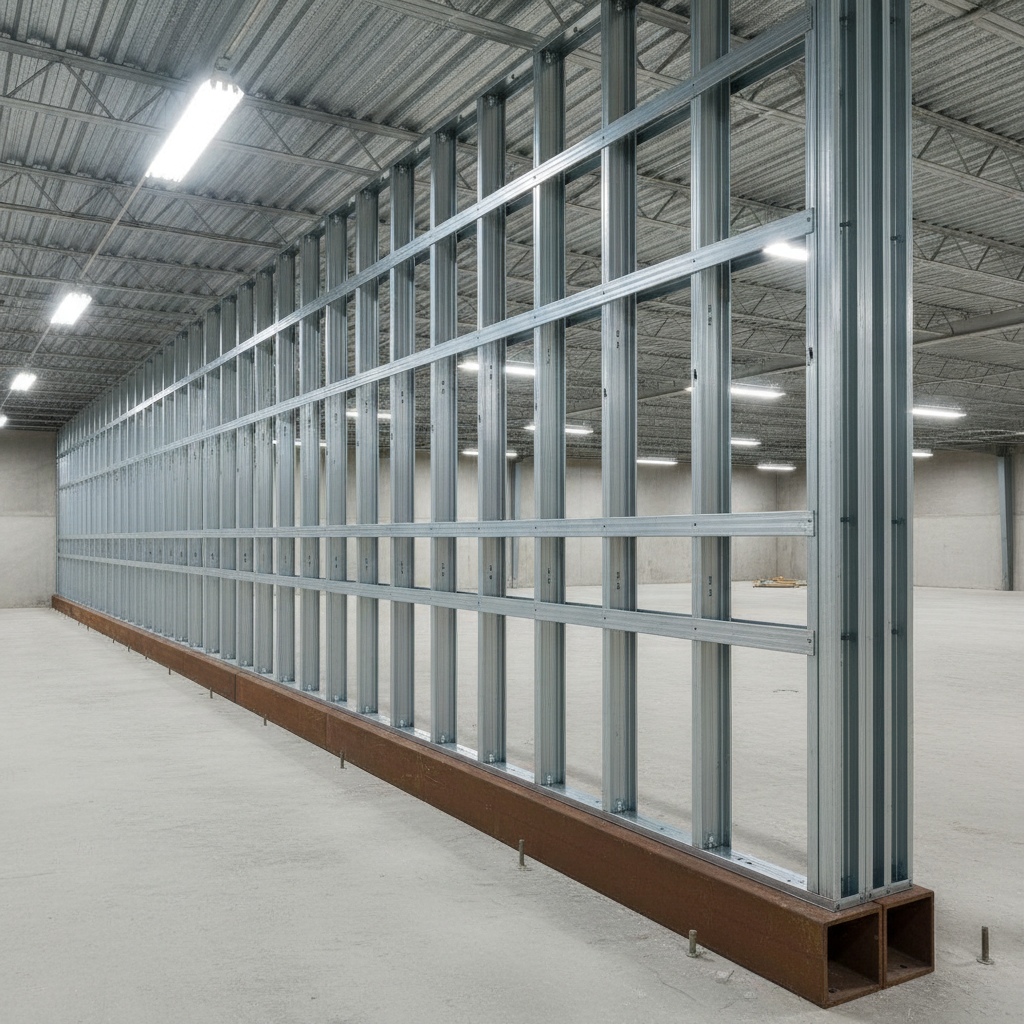
The scene below shows deeper floor track, a slotted head detail, and channels tying the field—exactly how a tall 6 in. wall stays straight under traffic and air pressure.
Need a fast width check? Email your wall height, spacing, and any load notes. Our engineering team will reply with a recommended stud width, matching track depth, and a simple bridging layout you can drop into your submittal.
Common Width Selection Mistakes (and How to Avoid Them)
Typical misses: treating 3-5/8 in. as universal, pushing 25 ga past ~12 ft, omitting head deflection on moving structures, under-bracing tall fields, and assuming width alone fixes acoustics. Tie width to height, loads, movement, STC goals—and document compatible tracks and channels.
- Defaulting to 3-5/8 in. everywhere: Past ~12 ft, many reviews will demand thicker gauge, more bracing, or a width bump. It’s often cleaner to start at 6 in.
- No head deflection detail: Fixed head + moving slab = cracked finishes. Slotted head track is how you keep gypsum happy while the structure breathes.
- Skipping bridging: On tall walls, lateral flutter shows up as screw pops and wavy finishes. Carrying channel stops it.
- MEP squeeze: Narrow studs mean crushed insulation and pinched conduits. Plan the cavity first—then pick the gauge.
- Sound shortcuts: Wider studs help, but resilient channel and sealant paths usually move the STC needle faster.
For quick size context, skim framing sizes. For a broader orientation, see the steel stud framing guide.
Specifying the Right Width for Your Project: A Practical Decision Framework
Decide width in this order: 1) height and loads, 2) cavity for MEP and insulation, 3) acoustic targets, 4) required head movement, then 5) bracing. Pick the narrowest width that passes those checks, and match gauge, track depth, and bridging spacing to complete the assembly.
Use this short checklist during takeoff and submittals:
- Define role: Partition or load-bearing? Interior or exterior? Target height and spacing (e.g., 16 in. o.c.).
- Shortlist widths: 2-1/2 in. and 3-5/8 in. for most interiors; 6 in.+ once you cross ~14–16 ft or pack services.
- MEP + insulation: Confirm device boxes, conduit bundles, and insulation thickness actually fit the cavity.
- Head movement: If the head needs to move, lock in slotted deflection track now.
- Bracing layout: Place carrying/bridging channels at the intervals your detail set calls for; don’t improvise on site.
- Finalize gauge: Light-gauge for non-structural; 20–16 ga (or heavier) for tall/structural spans.
| Project cue | Width that often fits | Accessory pairing |
|---|---|---|
| Slim partitions (8–10 ft) | 1-5/8 in. to 2-1/2 in. | Standard track; minimal bracing |
| Typical interior (10–12 ft) | 3-5/8 in. | Standard or slotted head track; add carrying channel |
| High services or higher STC | 4 in. to 6 in. | Deeper track; resilient channel per assembly |
| Tall/structural (14–20 ft+) | 6 in.+ | Deep/slotted head track; robust bridging grid |
Need Canadian sizing context? See steel stud framing sizes in Canada. For a materials primer, compare steel vs. wood studs.
FAQs on Steel Stud Widths
Most interiors run 3-5/8 in., but your height, loads, and MEP drive the final pick. Use 6 in.+ once spans increase, services stack up, or deflection and acoustic targets tighten. Pair width with the right track depth, gauge, and bridging for a stable, buildable wall.
What is the most common interior steel stud width?
3-5/8 in. is the workhorse because it balances stiffness, routing space, and gypsum compatibility. In typical 10–12 ft interiors, it passes review faster than narrower studs and pairs well with standard or slotted head tracks and carrying channel.
When should I move to a 6 in. stud?
Once unsupported height pushes ~14–16 ft, services pack the bay, or exterior/shaft conditions apply, 6 in.+ is usually cleaner. Reviewers often accept it faster than forcing 3-5/8 in. with heavy bracing.
How do width and gauge work together?
Width sets cavity and inherent stiffness. Gauge adds thickness and strength. For non-structural 10–12 ft spans, light-gauge often works. For taller or load-bearing spans, combine wider studs with 20–16 ga and a documented bracing plan.
Does slotted deflection track depend on width?
Use slotted deflection track whenever the design calls for vertical movement at the head. Width doesn’t remove the need—movement does. Your track depth just needs to match the chosen stud width.
Key takeaways
- Steel stud widths control capacity, cavity, and acoustics—pick them first.
- 3-5/8 in. is versatile to ~12 ft; 6 in.+ is the safer bet for ~14–16 ft and up.
- Head deflection, bridging, and resilient channel turn a good width into a great wall.
- Send us your heights and loads; we’ll return a buildable, review-ready package.
If you’re new to steel framing, start with our framing guide and this primer on metal stud dimensions.