Heavy gauge steel is cold-formed steel framing typically 54–118 mils thick, engineered for load-bearing walls, tall partitions, and high-demand details. At 370 New Enterprise Way in Vaughan, Dass Metal Products manufactures heavy-gauge studs, tracks, and channels that meet code, accelerate installation, and deliver reliable strength for commercial interiors and exteriors.
By Navjot Dass · Last updated: June 5, 2026
At a Glance: Heavy-Gauge Steel Framing
Heavy-gauge steel framing uses thicker, higher-strength cold-formed sections for structural or semi-structural walls. Typical thickness ranges from 54 to 118 mils (about 16–10 gauge). It enables taller walls, greater load paths, and tighter deflection control, making it ideal for multi-story commercial interiors and exterior curtain wall backups.
Here’s the short version before we dive deep. If your wall needs to carry axial loads, resist lateral forces, or exceed 12 feet in height, you’re likely in heavy-gauge territory. Designers commonly specify 16 gauge (54 mil) to 10 gauge (118 mil) with 3-5/8 inch, 6 inch, or 8 inch stud depths for spans between 10 and 24 feet.
- Higher capacity: heavier thickness, higher yield strength, and larger depths improve capacity for axial and bending demands.
- Deflection control: stiffer sections help meet L/240 or L/360 limits; slotted tracks decouple vertical movement.
- System completeness: combine studs, deep or standard tracks, bridging/carrier channels, clips, and bracing.
- Code-ready: engineered profiles align with common design checks for out-of-plane wind and in-plane load paths.
What Is Heavy Gauge Steel?
Heavy gauge steel refers to cold-formed studs, tracks, and channels thicker than light-gauge options, generally 54–118 mils (16–10 gauge). These sections provide higher axial, bending, and shear capacity for load-bearing walls, tall partitions, shaftwall backups, and exterior framing subjected to wind and seismic forces.
In plain terms, thickness drives strength. A 68 mil (14 gauge) stud carries more load and deflects less than a 33 mil (20 gauge) stud of the same depth. That’s why projects with 14–20 foot spans, door headloads, or heavy cladding often step into heavy-gauge framing with 6 inch or 8 inch depths.
At Dass Metal Products in the Regional Municipality of York, our engineering team pairs profile geometry with required thickness to fine-tune capacity. For instance, a 6 inch 54 mil stud at 16 inches on center can often achieve L/240 at 14–16 feet, while an 8 inch 68 mil stud extends spans to 18–20 feet, depending on sheathing and loads.
Why Heavy-Gauge Steel Matters
Heavy-gauge framing matters because it increases capacity, controls drift, and supports taller or loaded walls. It reduces call-backs from cracking or out-of-plumb issues and helps pass inspections by keeping deflection within L/240–L/360 limits under wind or live loads.
Performance shows up in numbers. For example, every step up in gauge (e.g., 54 to 68 mil) can add double-digit percentage increases in moment of inertia at the same depth, curbing midspan deflection by noticeable margins over 12–20 foot heights. That translates into straighter finishes and fewer drywall repairs over the building life.
- Better load paths: axial loads from floor or roof transfer through studs into tracks and slabs cleanly.
- Taller walls: 16–20 foot interior partitions are common in gyms, warehouses, and retail shells.
- Cladding support: brick veneer, stone, or heavy rainscreen systems demand stiffer backup framing.
- Service integration: deeper webs improve space for 1–4 inch MEP penetrations while maintaining capacity.
We’ve seen crews save days by selecting a 6 inch 68 mil layout at 16 inches on center rather than forcing a 6 inch 54 mil layout at 12 inches on center. Fewer members often means fewer cuts, fewer screws, and fewer bridging pieces—productivity compounds fast in corridors longer than 100 feet.
How Heavy-Gauge Framing Works
Heavy-gauge framing works by combining thicker studs with engineered tracks, bridging, and clips to manage axial, lateral, and deflection demands. System behavior depends on stud depth, thickness, spacing (12/16/24 inches), sheathing type, and support conditions at the slab and structure above.
Think of the wall as a beam-and-column hybrid. Each stud resists out-of-plane wind like a vertical cantilever while also carrying vertical loads. Tracks act as seat and cap; slotted deflection tracks permit 1/2–3/4 inch vertical movement so floor deflection doesn’t crush the wall. Bridging channels at 4–8 foot intervals limit stud buckling.
- Stud depth: common heavy-gauge depths are 3-5/8 in, 6 in, and 8 in; deeper = stiffer.
- Stud thickness: 54, 68, 97, and 118 mils map roughly to 16, 14, 12, and 10 gauge.
- Spacing: 12 in on center boosts capacity; 16 in is the commercial standard; 24 in saves weight where loads allow.
- Sheathing: 5/8 in gypsum and 7/16–5/8 in exterior sheathing improve composite action, reducing deflection.
- Bridging: 1-1/2 in carrying channels or flat straps at set elevations reduce lateral-torsional buckling risks.
For step-by-step system thinking—and how it ties into stud sizing—see our steel framing dimensions guide. If your design flips between 54 and 68 mils, our 16 gauge metal studs primer offers quick rules of thumb for spans between 12 and 18 feet.
Types, Components, and Approaches
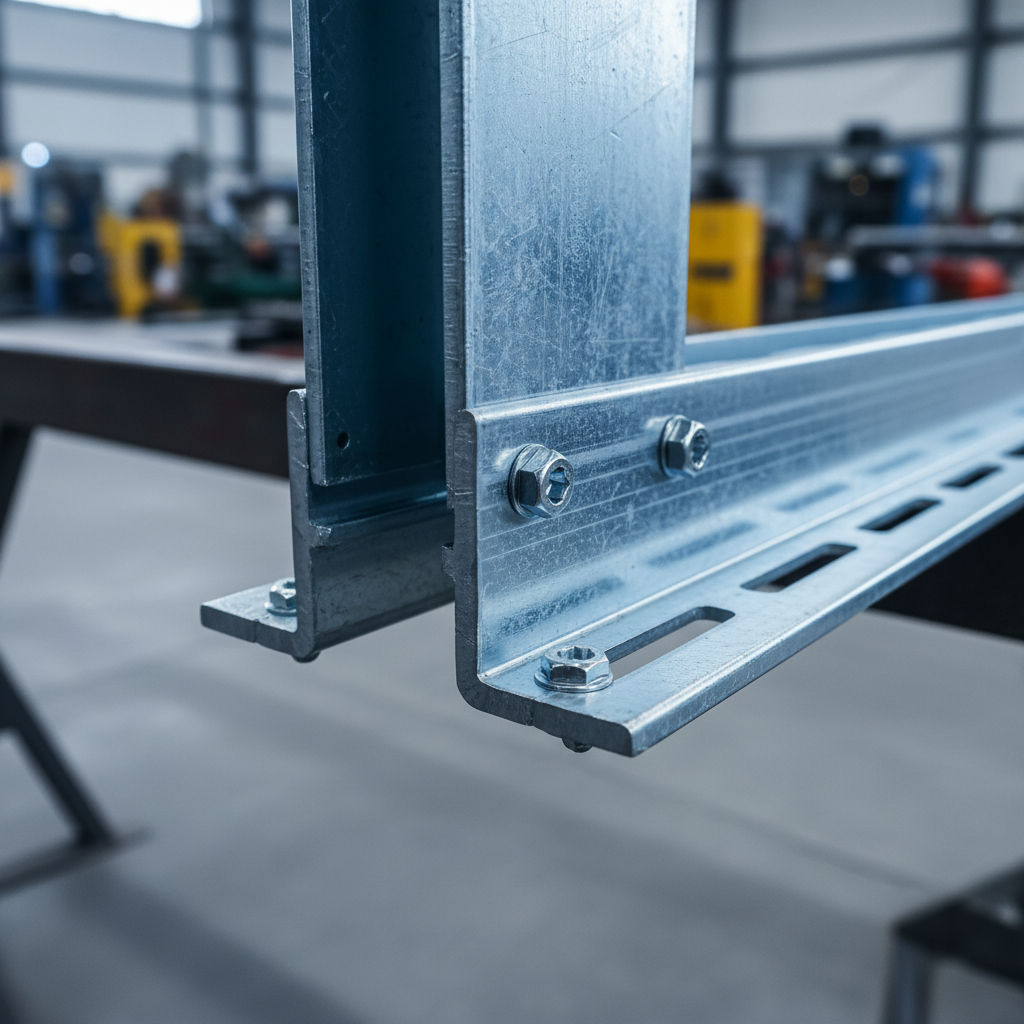
A complete heavy-gauge system blends load-bearing studs, standard or deep track, slotted deflection track, bridging/carrying channel, resilient channel for acoustics, and purpose-built clips. Choosing the right combination controls deflection, handles movement, and speeds installation on multi-story projects.
Core heavy-gauge components
- Load-bearing studs (heavy-gauge): 54–118 mil studs for axial + out-of-plane demands. Explore our product scope in the load-bearing stud framing system.
- Standard and deep track: Deep track (e.g., 2 in legs) provides extra screw edge distance and stability for taller walls.
- Slotted deflection track: Allows 1/2–3/4 in vertical slip at the head to protect finishes and prevent load transfer from slabs above.
- Bridging/carrying channel: Typically 1-1/2 in; installed every 4–8 ft to curb buckling in 14–10 gauge studs.
- Clips and connectors: Deflection side clips, webslide clips, and bridging clips simplify head-of-wall, drift, and bracing details.
- Acoustics aides: Resilient channel and furring channel decouple gypsum layers, improving STC by 5–10 points when detailed right.
Approaches for typical conditions
- Tall interior partitions (14–20 ft): 6 in 54–68 mil at 16 in o.c., deep track at base/head, bridging at ~5–6 ft intervals.
- Exterior backups (wind 25–50 psf): 6–8 in 68–97 mil, sheathed both sides or exterior only; slotted head track to accommodate slab movement.
- Shaftwall and stair cores: Heavy-gauge CH/shaft studs with 1–2 hr assemblies, bridging to resist construction-phase loads.
- Door and opening jambs: Boxed studs (2-ply) or 97 mil studs; headers with back-to-back joists or track caps for 3–6 ft openings.
- Acoustic partitions (STC ≥ 50): Heavy-gauge only where structure requires; use resilient channel and insulation for performance without overbuilding studs.
Not sure which path is best? Compare heavy vs. light framing strategies in our light gauge framing guide and get specification shortcuts in what is light gauge steel framing.
Best Practices for Specifying and Installing
Successful heavy-gauge installs pair correct sizing with movement control and repeatable field steps. Use deep or slotted tracks where required, set stud spacing to load, add bridging at designed intervals, and document L/240–L/360 checks. Consistency prevents rework and inspection delays.
Specification checklist
- Define span and loads: Height (e.g., 16 ft), wind (psf), and superimposed dead loads (kips). Document L/240 or L/360 deflection limits.
- Pick depth first: 6 in covers many 14–18 ft spans; jump to 8 in beyond 18–20 ft or with heavy cladding.
- Select thickness: 54 mil for moderate spans; 68 mil for stiffer control; 97–118 mil near openings or high loads.
- Movement joints: Slotted deflection track at head; slip screws through slots with required edge distances (often 3/4–1 in).
- Bridging layout: 1-1/2 in channel or straps at 4–8 ft elevations; first line at 4–5 ft above slab for 16–20 ft walls.
- Fastener schedule: Head/base screws typically 12 in o.c.; studs to track 2 screws per flange; check manufacturer data.
Field installation flow (repeatable steps)
- Layout: Snap lines; mark door/window rough openings; verify slab level within 1/4 in over 10 ft.
- Base track: Anchor at 24–32 in o.c.; use deep track for tall walls to increase stability and screw clearance.
- Stud cut & place: Cut 1/2–3/4 in short for slip at head; insert into slotted track; plumb and clamp.
- Fasten: Use #8 or #10 screws; two per flange at track connections; maintain required edge distance (≥3/8 in).
- Bridging: Install first line at 4–5 ft; subsequent lines every 4–6 ft; lock with bridging clips.
- Sheathing: Hang per pattern; stagger seams; screw 8 in o.c. at edges, 12 in o.c. in field.
Need a second opinion on a borderline span? Our engineers at heavy-gauge framing helps share quick checks and field-proven details that cut RFIs on 12–24 ft walls.
Tools and Resources You Can Use Today
Leverage product data, span guidance, and installation references to move from concept to close-out faster. Clear resources reduce RFIs, accelerate approvals, and keep 12–20 foot walls on schedule—especially where head-of-wall deflection and wind drift control are critical.
- Heavy-gauge system page: Review scope, depths, and typical details on our load-bearing stud framing system.
- Light-gauge for reference: For non-structural partitions and ceilings, see non-load-bearing steel framing.
- Span primers: See our dimensions guide and 16 gauge overview to approximate layouts before final calcs.
- Reinforcement context: For concrete interface planning (anchors, embeds), skim this steel rebar guide from our sister company.
Local considerations for 370 New Enterprise Way
- Plan deliveries to avoid peak activity near the Highway 50 – Zum Queen Stop EB area; early morning drops shorten unload to 20–30 minutes for bundled studs.
- Winter sequencing matters in the Regional Municipality of York; pre-stage 6–8 inch 68–97 mil studs indoors to prevent finger injuries below 32°F and keep coatings dry.
- For quick pick-ups, coordinate staging lanes along Queen St / Highway 50; our team can palletize by height (12–20 ft) to cut jobsite sort time by 30–40%.
Case Studies and Field Examples
On recent Ontario and U.S. projects, heavy-gauge framing enabled 14–22 foot spans at 16 inches on center using 6–8 inch depths. Crews reported fewer call-backs for cracking, faster door jamb setups, and improved inspection outcomes thanks to documented L/240–L/360 checks.
Warehouse office core (18 ft partitions)
A retrofit required 18 ft interior partitions beside an active dock. Using 6 in 68 mil studs at 16 in o.c., deep track, and two lines of bridging at ~5 and ~10 ft, crews hung 5/8 in gypsum both sides. Door jambs used boxed 68 mil studs. Final deflection checks confirmed L/240 at design wind, with head track slip screws set through 3/4 in slots.
Retail shell, exterior backup (20–22 ft)
Cladding was heavy rainscreen over 7/16 in exterior sheathing. The team chose 8 in 68–97 mil studs at 16 in o.c., slotted deflection track, and three lines of bridging at 6 ft spacing. Inspector sign-off was first-pass after verifying spacing and fastener schedules (12 in o.c. at edges, 8 in near openings). Punch-list shrinkage: under 2% of wall area.
School gym acoustics (STC ≥ 50)
Acoustic partitions (14–16 ft) paired 6 in 54 mil studs with resilient channel and insulation, yielding 50+ STC assemblies. Only jambs and headers used 68–97 mils. The mixed approach cut material count ~15% while meeting sound and drift goals.
Heavy vs. Light Gauge: Quick Comparison
Use light gauge for non-structural interior partitions and ceilings; use heavy gauge when walls are tall, carry load, or back heavy cladding. Depth, thickness, spacing, and sheathing together determine performance, cost, and speed—balance them deliberately for each condition.
| Category | Light Gauge (typ.) | Heavy Gauge (typ.) |
|---|---|---|
| Thickness (mils) | 15–43 (25–18 ga) | 54–118 (16–10 ga) |
| Common depths | 2-1/2 in, 3-5/8 in | 3-5/8 in, 6 in, 8 in |
| Spacing | 16–24 in o.c. | 12–16 in o.c. |
| Typical uses | Non-structural partitions | Load-bearing, tall walls, exterior backups |
| Deflection targets | L/240 interior | L/240–L/360 exterior/interior |
Want a deeper dive into light framing? Our light gauge framing guide walks through spacing, fastening, and acoustic layouts you can adapt to heavy-gauge conditions.
On-Site Tools, Materials, and Checklist
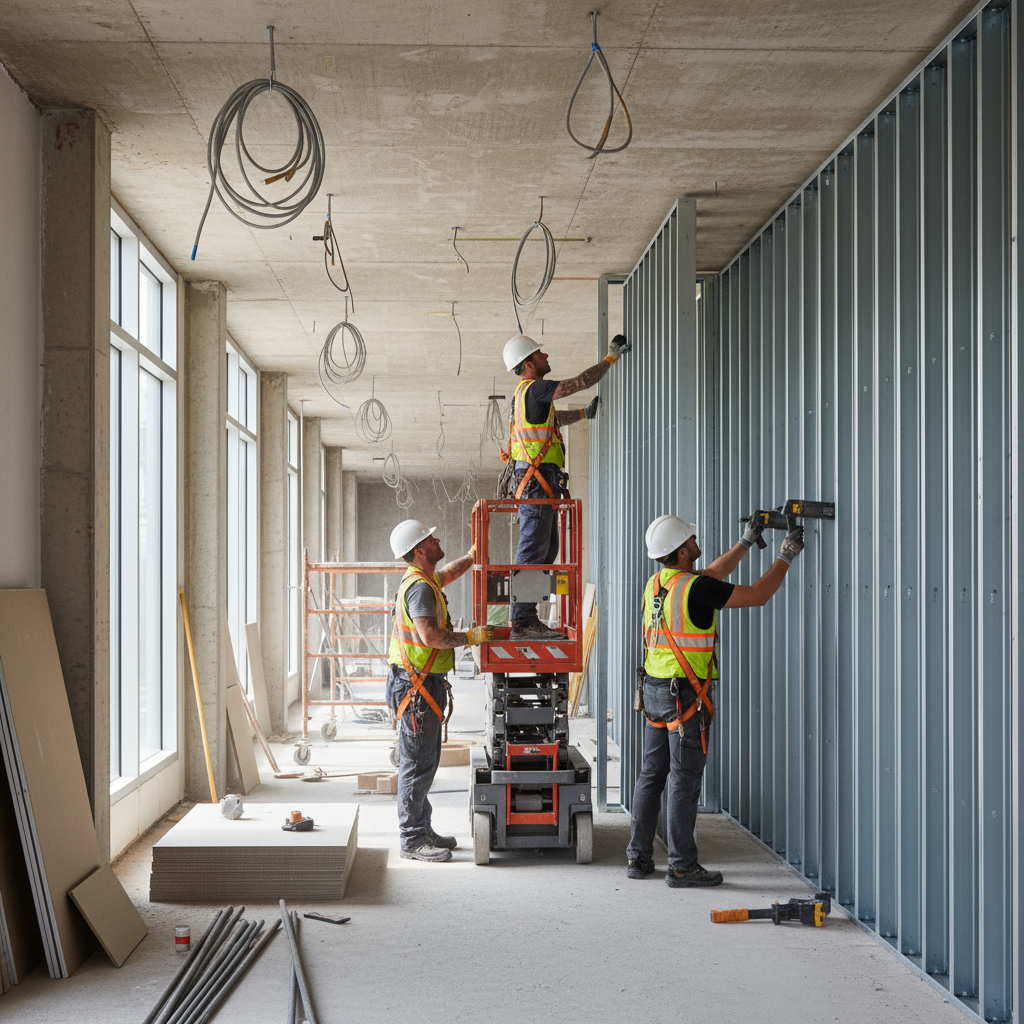
Crews move faster when the right tools and consumables are staged per zone. Prepare anchors, screws, clips, channel, and PPE for each 50–80 foot segment. Pre-bundle 12–20 foot studs by height and depth so two installers can stand, plumb, and fasten with minimal material handling.
- Anchors and pins: match to slab (normal vs. post-tension); verify embed and spacing (24–32 in o.c.).
- Screws: #8/#10 self-drilling; head-of-wall slip screws; corrosion-resistant for exterior or wet zones.
- Clips: deflection side clips and webslide/bridging clips in quantities per 4–8 ft elevations.
- Channels: 1-1/2 in carrying channel; flat straps for alternative bracing.
- Sheathing: 5/8 in gypsum interior; 7/16–5/8 in exterior with WRB per envelope spec.
- PPE and handling: gloves for 68–118 mil edges; lifts for preassembled panels over 12 feet tall.
For load-bearing details and product scope, visit the heavy-gauge system page. For non-structural scope and ceiling grids, see non-load-bearing framing.
Heavy Gauge Steel FAQ
These quick answers address the most common field and design questions about heavy-gauge framing—spans, spacing, movement, and acoustics. Each response is concise so you can move on-site decisions forward without delays.
What counts as heavy gauge for steel studs?
In commercial framing, heavy gauge generally means 54–118 mil thickness, often labeled 16–10 gauge. You’ll see these in 3-5/8, 6, or 8 inch depths for spans between about 12 and 24 feet, load-bearing walls, or exterior backup framing under wind loads.
When should I use a slotted deflection track?
Use slotted head track whenever the structure above is designed to deflect under live load. The slots allow 1/2–3/4 inch vertical slip so slab movement doesn’t crush partitions or telegraph cracks into the finish—which helps meet L/240–L/360 limits.
How do I control stud buckling in tall walls?
Install bridging or carrying channel lines every 4–8 feet. Place the first line around 4–5 feet above the slab on 16–20 foot walls. Use bridging clips to fix the channel and maintain stud alignment during sheathing and service penetrations.
Is heavier always better for acoustics?
Not necessarily. Acoustics improve more from decoupling and damping than simply thicker studs. Resilient channel, insulation, and staggered fasteners can add 5–10 STC points. Use heavy gauge only where the structure or height requires it, especially at jambs and headers.
Conclusion
Heavy gauge steel framing delivers the strength, control, and predictability needed for tall or loaded walls. Specify depth first, then thickness, then spacing. Add slotted tracks and bridging as the condition demands. This disciplined approach shortens schedules and reduces call-backs.
Key takeaways
- Define span, loads, and deflection targets (L/240–L/360) before choosing thickness.
- Use deep or slotted tracks to manage movement; cut studs 1/2–3/4 in short at the head.
- Install bridging every 4–8 ft to control buckling and keep lines true.
- Right-size: 6 in 54–68 mil covers many 14–18 ft spans; jump to 8 in for 18–22 ft or heavy cladding.
Next steps
- Review our heavy-gauge system details and share your span/deflection targets.
- Compare interior layouts with the light gauge reference to avoid overbuilding.
- Have a borderline case? Send heights, spacing, and sheathing to our team—turnaround is typically same-day.
Soft CTA: Want a quick specification review from engineers who build this every day? Reach out via our heavy-gauge system page and we’ll respond with a simple markup and suggested layout.