Metal furring comparison
Short answer: hat-shaped furring channel creates a regular attachment plane and shallow cavity; resilient channel is used only within a compatible acoustic assembly; Z-shaped furring creates a different stand-off and fastening geometry; carrying-channel systems support suspended work; and direct attachment or independent framing may fit other conditions. Choose the documented assembly, not the profile that looks closest.
Technical boundary: this comparison does not design an assembly, select spacing or fasteners, assign loads, predict acoustic or fire performance, approve a substitution, or establish code compliance. Project professionals, approved documents, tested or listed assemblies, substrate conditions and authorities control. Dass product facts and availability must be rechecked. No certification, load, warranty or performance claim is made.
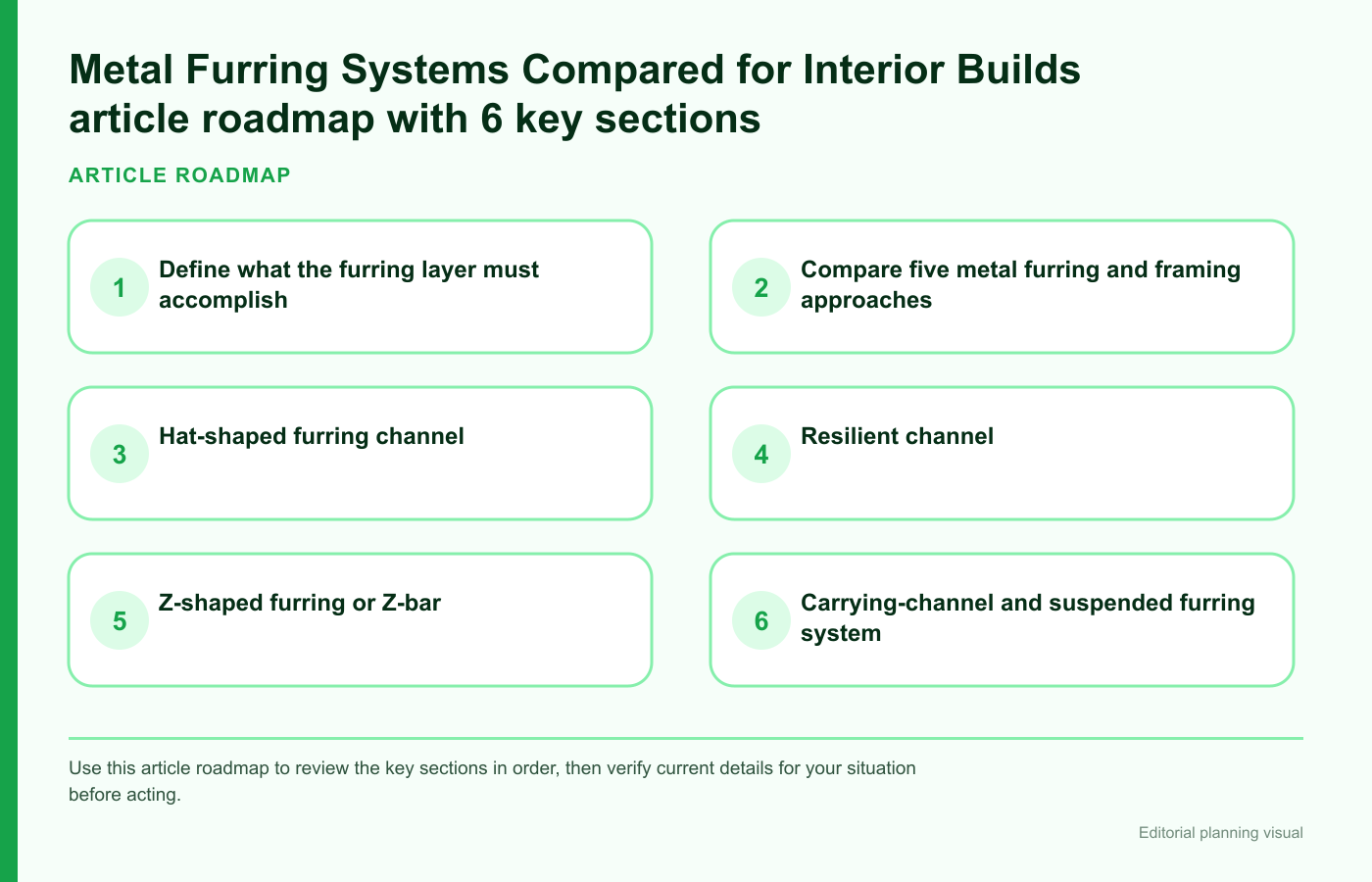
Define what the furring layer must accomplish
Furring can create a straight attachment plane over an uneven substrate, provide a controlled stand-off, support finishes, coordinate a service cavity, form part of a suspended ceiling or participate in a tested acoustic or fire assembly. These objectives are different. A profile selected for finish attachment should not be assumed to provide acoustic isolation, structural bracing or exterior cladding support.
Dass Metal Products describes its furring channel as a hat-shaped section used as a base for finished wall materials and in wall or ceiling applications. The page publishes dimensions and gauge labels but also tells buyers to contact the company for current information. This article does not turn those public figures into a project specification or repeat its broad performance language as a verified result.
CSSBI’s non-loadbearing steel framing guide specification includes metal furring within a broader specified system. That means substrates, hangers, carrying members, channels, fasteners, board, joints, movement and performance requirements must be coordinated together.
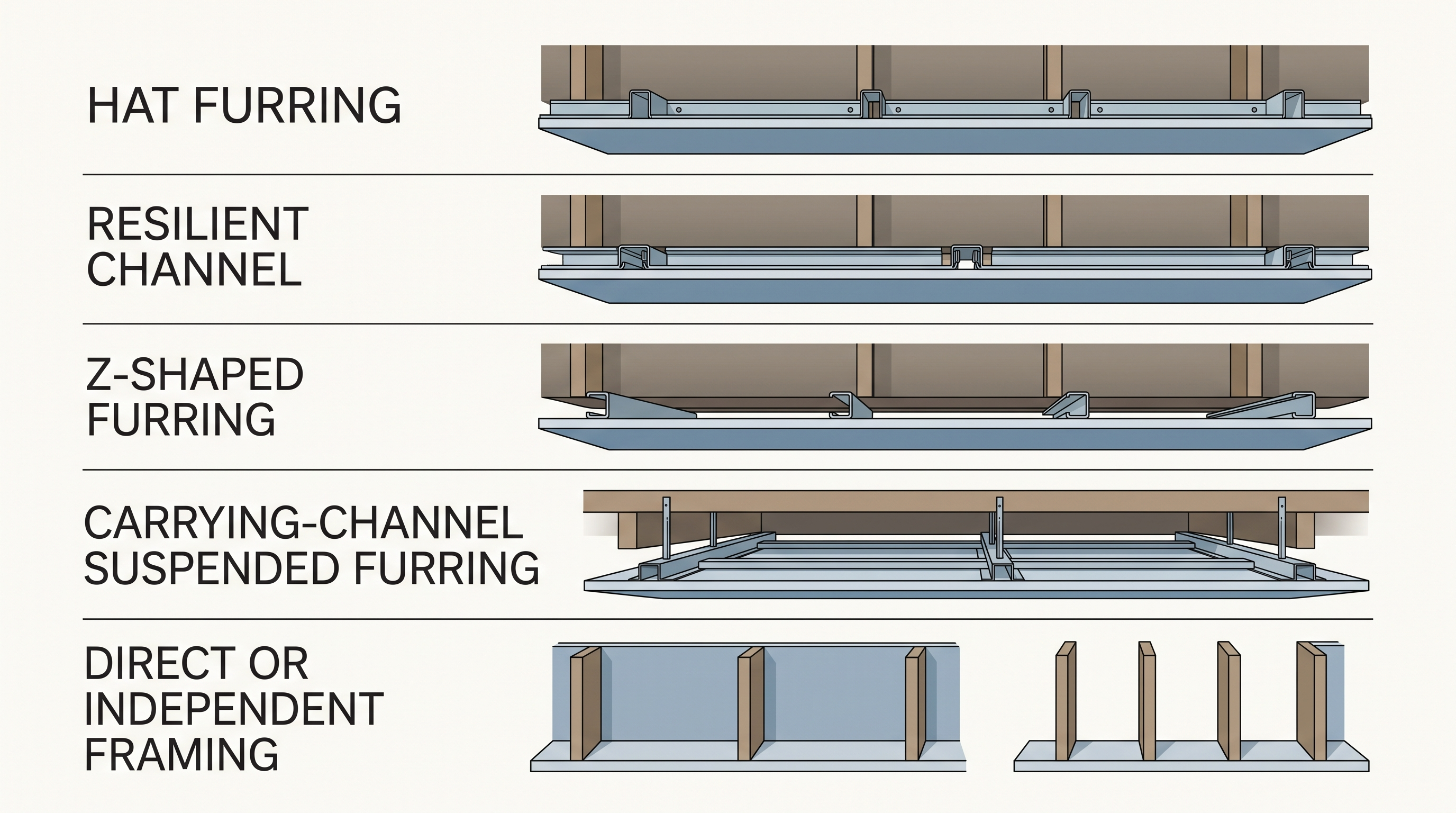
Compare five metal furring and framing approaches
Hat-shaped furring channel
Primary decision: create a repeated fastening plane and shallow cavity over framing or another approved substrate. Trade-off: section, thickness, spacing, fasteners, orientation and substrate capacity must support the actual finish and loads. Fits: details that explicitly call for hat furring and provide connection and support requirements.
Resilient channel
Primary decision: form part of a specific acoustic decoupling assembly. Trade-off: orientation, fastener placement, spacing, board layers, perimeter details and bridging can determine whether the tested intent is preserved. Fits: an approved acoustic assembly—not a generic substitute for rigid furring.
Z-shaped furring or Z-bar
Primary decision: provide a stand-off or attachment geometry required by the wall, insulation, panel or transition detail. Trade-off: the profile can create a different thermal, structural and fastening path than hat channel. Fits: a project detail that defines the Z section, substrate, orientation and finish.
Carrying-channel and suspended furring system
Primary decision: suspend or support a ceiling or furred assembly using hangers, carrying channels, clips and furring components. Trade-off: hanger loads, spacing, bracing, elevation, services and connections require coordinated design. Fits: documented suspended systems; it is not simply hat channel fixed to a wall.
Direct attachment or independent stud framing
Primary decision: determine whether furring is needed at all. Direct board attachment may fit a suitable approved frame, while independent studs can create a deeper service cavity or separate wall. Trade-off: each changes floor area, coordination, loads, acoustic paths and finish alignment. Fits: designs where the approved assembly and substrate support that approach.
Use the same criteria for each furring option
| Criterion | Question | Why it separates options |
|---|---|---|
| Assembly role | Levelling, stand-off, finish support, acoustics, suspended ceiling, services or independent wall? | No profile performs every role by default. |
| Substrate | Steel studs, masonry, concrete, wood, structure or carrying channel? | Anchor and capacity requirements change. |
| Geometry | What cavity depth, face width, orientation and clearances are required? | Coordinates finishes, services and intersections. |
| Loads | Board, cladding, fixtures, services, pressure or other demand? | Finish weight and attachment cannot be assumed. |
| Spacing and support | What member, hanger, fastener and bracing layout is designed? | Profile selection is inseparable from support conditions. |
| Movement | What building, substrate, ceiling or finish movement must remain free? | Rigid connections can create unintended restraint. |
| Acoustic and fire | Is the work part of a tested or listed assembly? | Small substitutions can change system performance. |
| Moisture and corrosion | What exposure, coating and material compatibility apply? | Interior assumptions may not fit damp or exterior conditions. |
| Services | Which ducts, pipes, conduits, boxes and access panels cross the cavity? | Uncoordinated penetrations can bridge or overload the system. |
| Finish tolerances | What plane, level, joint and substrate tolerances must be achieved? | Furring cannot compensate for every substrate defect. |
Match the system to a documented fit scenario
Levelling an uneven interior substrate: hat furring may create a regular plane when the detail defines attachment, shimming or adjustment, spacing, finish and tolerance. Confirm substrate capacity and avoid assuming the channel corrects major movement or deterioration.
Improving acoustic separation: use the exact tested or designed assembly. A resilient channel and a rigid hat channel are not interchangeable, and fasteners or services that bridge the decoupled layer can undermine the intent. Do not publish an STC improvement without the exact assembly evidence.
Creating a service cavity: compare cavity depth, service size, access, box support, penetrations, firestopping and finish attachment. Independent framing may be more suitable than shallow furring when services are extensive; the designer must decide.
Suspended drywall ceiling: coordinate hangers, carrying channels, clips, furring, perimeter conditions, loads, deflection, services and board. CFSEI’s technical-note catalogue shows how cold-formed steel guidance distinguishes connections, nonstructural members, bracing, fire and acoustic topics.
Exterior or moisture-exposed use: do not extend an interior product statement to exterior cladding. Confirm material, coating, drainage, ventilation, thermal, structural and corrosion requirements with the project professionals and current product data.
Compare submittals and quotations before substitution
- Identify the drawing, detail, assembly, specification section and current revision.
- Name the proposed system and the role of every channel, clip, hanger, fastener and finish.
- Provide dimensioned sections, material, design thickness, coating and product markings.
- Show substrate, orientation, spacing, support, connections, movement and edge conditions.
- Provide applicable load, evaluation, fire or acoustic evidence for the exact assembly—not a similar system.
- Coordinate penetrations, fixtures, services, access panels and perimeter treatment.
- List quantities, lengths, fabrication, bundle labels, delivery, storage and exclusions.
- Obtain written design-professional acceptance for substitutions before release.
Dass also publishes separate pages for resilient channel and Z-bar. Use those pages to request current product data, not to assume equal performance. Dass’s contact route is the appropriate next step for availability and quotation.
Stop when these furring red flags appear
- The proposal says only “metal furring” with no profile or assembly role.
- Hat channel and resilient channel are treated as interchangeable.
- Acoustic, fire, load or corrosion claims have no exact assembly evidence.
- Spacing and fasteners come from a different substrate or finish.
- Gauge is used without design thickness and product data.
- Services, fixtures or access panels will load or bridge the furring without coordination.
- Exterior exposure is proposed using interior assumptions.
- A substitution is ordered before the design team reviews it.
- Custom lengths, punches or bundles lack approved drawings and traceable labels.
Common metal furring comparison mistakes to avoid
Do not compare only profile depth or unit price. Include clips, hangers, anchors, fasteners, labour interfaces, waste, services, board, finishing and delivery. Do not claim that a hat channel inherently improves acoustics; system performance depends on the full tested or designed assembly.
Do not copy a spacing, load or fastener schedule from a brochure into another project. Do not select a heavier member by intuition and call it equivalent. Changes in stiffness, geometry and attachment can shift forces or conflict with listed details. Resolve the system at submittal stage and verify markings at delivery.
Frequently asked questions
Are furring channel and resilient channel the same?
No. They have different roles and cannot be interchanged without reviewing the full assembly.
Does metal furring automatically improve sound control?
No. Acoustic performance depends on the complete tested or designed assembly, including channels, board, insulation, fasteners, joints and penetrations.
Can hat channel support any wall finish?
No. Finish weight, loads, substrate, member, spacing, fasteners and connections require project-specific verification.
Which Dass furring product fits my project?
This article does not select one. Send the approved assembly and requirements to Dass and obtain design-professional review.
Send the complete assembly for comparison
Use Dass Metal Products’ contact form with the approved details, substrate, finish, loads, performance requirements, quantities and delivery scope. Final technical, certification, compliance, availability, price and advertising review are required before publication.