
Metal stud wall STC ratings describe how well a metal stud wall assembly blocks airborne sound. Higher STC means less noise transfer between rooms. At 370 New Enterprise Way in Vaughan, our Dass Metal Products team helps contractors select studs, tracks, channels, and details to hit target ratings with confidence.
By Navjot Dass — Dass Metal Products
Last updated: 2026-06-22
Above-Fold: Hook + Table of Contents
To improve STC in metal stud walls quickly, combine mass (double drywall), absorption (mineral wool), and decoupling (resilient channel, clips, or double-stud). Then seal every seam. This layered strategy routinely outperforms single upgrades and helps pass field tests with fewer surprises.
You can reach your STC goal without guesswork. Use this guide to understand the acoustic levers, compare assemblies, and translate design intent into repeatable field results.
- Quick Summary
- What Is STC for Metal Stud Walls?
- Why STC Ratings Matter (Local Context)
- How STC Works: Practical Physics
- Assembly Types & Typical STC Ranges
- Best Practices & Common Mistakes
- Tools & Resources
- Case Studies & Examples
- FAQ
- Conclusion + Key Takeaways
Summary
STC (Sound Transmission Class) is the lab rating for how much airborne sound a wall blocks. Aim for STC 50+ for inter-unit separation and 45–55 for offices, classrooms, and exam rooms. Combine mass, mineral wool, and decoupling, then ensure airtight detailing at every perimeter and penetration.
Here’s what consistently works on Dass Metal–supported builds across Ontario and U.S. jobs with dependable cross‑border delivery:
- Mass: Two layers of 5/8 in. Type X gypsum per side often add 4–8 points versus single layers.
- Absorption: Mineral wool in the cavity typically adds 3–5 points compared with empty studs.
- Decoupling: Resilient channel or isolation clips commonly deliver 6–10 points; double-stud can reach the high 50s to 60+.
- Airtightness: A continuous acoustic bead at floor, head, and verticals can be the difference between pass and fail.
For deeper framing context, see our metal stud framing guide for how studs, tracks, and channels come together in a complete system.
What Is STC for Metal Stud Walls?
Sound Transmission Class (STC) is a single-number rating that indicates how much airborne sound a wall blocks across mid-to-high frequencies. In metal stud walls, STC depends on gypsum layers, stud gauge and spacing, cavity insulation, decoupling hardware, and airtight perimeter detailing.
STC is derived from standard lab measurements across 125–4000 Hz. Practically, every increase of roughly 10 STC points is heard as about half as loud for speech. A basic single-stud wall with single 1/2 in. gypsum on both sides can land in the mid‑30s. Add mineral wool and resilient channel, and you can reach the high‑40s to 50+ in lab assemblies.
- Lab vs. field: Field scores (per room-to-room tests) often trail lab results by a few points because of real‑world flanking.
- Frequency caveat: STC underweights very low bass; spaces with sub‑bass energy may need additional strategies.
- Use case: Treat STC as a comparison tool and target—not your only performance guarantee.
New to steel components? This steel studs guide explains gauges, dimensions, and how components influence structural and acoustic behavior.
Why STC Ratings Matter (Local Context)
For projects near 370 New Enterprise Way in the Regional Municipality of York, STC protects comfort, privacy, and compliance. Many multifamily and healthcare designs aim for STC 50+ between units and 45+ to corridors. Meeting these levels reduces complaints and rework at occupancy.
Why the number matters to owners, tenants, and inspectors:
- Code-aligned targets: Apartment and condo separations commonly target STC 50 (lab) / ~45 (field) as a minimum in North American practice.
- Complaint reduction: A miss of 3–5 points can trigger callbacks; tightening seals and controlling flanking often recovers those points.
- Space-specific goals: Speech privacy in exam rooms, offices, and classrooms often targets STC 45–55.
Local considerations for 370 New Enterprise Way
- Time deliveries around activity near the Highway 50 – Zum Queen Stop EB transit node so mineral wool and boards stay dry and staged.
- Winter work in Vaughan needs warmed sealants; cold beads lose adhesion and can shave several points off field STC.
- Use slotted deflection track where head-of-wall movement is expected to maintain isolation and structural accommodation.
If you are coordinating interiors, our team can align acoustic targets with framing schedules and submittals so trades know exactly what to build—and why.
How STC Works: Practical Physics
Metal stud wall STC improves when you add mass, absorb cavity energy, break vibration paths, and seal leaks. Combine layered gypsum, mineral wool, and decoupling (resilient channel or clips) with continuous acoustic sealant to get reliable, repeatable gains on site.
Translate physics into steps you can enforce during framing and board-up:
- Mass: Add layers of gypsum to raise surface density and shift resonance peaks higher.
- Absorption: Fill cavities with mineral wool to damp standing waves and reduce coincidence dips.
- Decoupling: Use resilient channel, isolation clips with 7/8 in. hat channel, or staggered/double studs to break direct paths.
- Airtight: Apply acoustic sealant at floor, head, and vertical edges, and around boxes and pipes; one missed joint can drop field results by multiple points.
- Continuity: Extend walls to the deck or seal flanking voids at ceilings, bulkheads, and behind millwork.
In our experience supporting dozens of interiors each season, executing these five levers lifts performance by 6–12 STC points compared with a bare single‑stud baseline—provided penetrations and perimeters are sealed and resilient components aren’t short‑circuited by fasteners.

Need to coordinate trades? Mark the noisy side for resilient channel, verify channel orientation, and enforce screw lengths so fasteners don’t hit studs. A 1/4 in. gap at perimeters, backer rod where needed, and continuous acoustical caulk create the airtight envelope that protects your STC.
Assembly Types & Typical STC Ranges
Metal stud wall options span mid‑30s STC (basic, single layer) to 60+ (double studs, double layers, mineral wool, resilient mounting). Choose based on occupancy, wall thickness, head movement, and willingness to manage clips, channels, and sealants with discipline.
Use these patterns to plan. Final results vary with board type, gauge, spacing, and workmanship—but the ranges below are a dependable starting point for submittals and mockups:
| Assembly | Key elements | Typical STC range |
|---|---|---|
| Single stud, basic | 3‑5/8 in. studs @ 24 in. o.c.; single 1/2 in. gypsum/side | STC 33–36 |
| Single stud + insulation | As above + mineral wool in cavity | STC 37–41 |
| Single stud + resilient channel | RC one side + mineral wool | STC 45–50 |
| Single stud, double layer | Two 5/8 in. Type X each side + mineral wool | STC 50–54 |
| Staggered stud | 2×4 studs on 6 in. track, offset studs + mineral wool | STC 50–55 |
| Double stud | Independent studs, 1 in. air gap, mineral wool | STC 55–62 |
| Clips + hat channel | Isolation clips, 7/8 in. channel; double board noisy side | STC 53–60 |
Where head-of-wall movement is specified, select slotted deflection track to keep isolation intact while accommodating structure drift. For lateral restraint, use bridging / carrying channel with acoustic‑friendly clips so the wall is stable without hard‑coupling both faces.
For more background on framing layout and spacing, see metal stud framing sizes and spacing norms that influence both structure and acoustics. If your demising wall carries loads, our load bearing stud framing specialists will help you balance structure, drift, and sound isolation.
Drywall details matter too. Our drywall and metal studs guide covers board types, layer counts, and joint staggering that tighten up your acoustic result.
Best Practices & Common Mistakes
Most STC losses come from flanking and air leaks. The best results come from airtight perimeters, controlled penetrations, correctly installed resilient components, and consistent, high‑mass layers—built per spacing and screw patterns that avoid short‑circuiting.
Do this consistently
- Run acoustic sealant continuously at floor, head, and vertical edges; 1/4 in. gaps allow a full bead.
- Specify mineral wool full‑height, lightly friction‑fit; don’t overcompress.
- Use resilient channel or isolation clips on the noisy side; maintain orientation and spacing per guide.
- Select slotted deflection track at the head of wall where movement is required.
- Offset electrical boxes; use putty pads; never back‑to‑back within a single cavity.
- Carry walls to the deck or seal above‑ceiling flanking paths with gypsum and sealant.
Avoid these pitfalls
- Gaps at perimeters or missing caulk beads (easy 3–5 point loss).
- Fastening gypsum directly to studs where RC or clips were specified.
- Empty cavities in spaces that need speech privacy.
- Unsealed pipe chases or corridor plenum paths that bypass the wall.
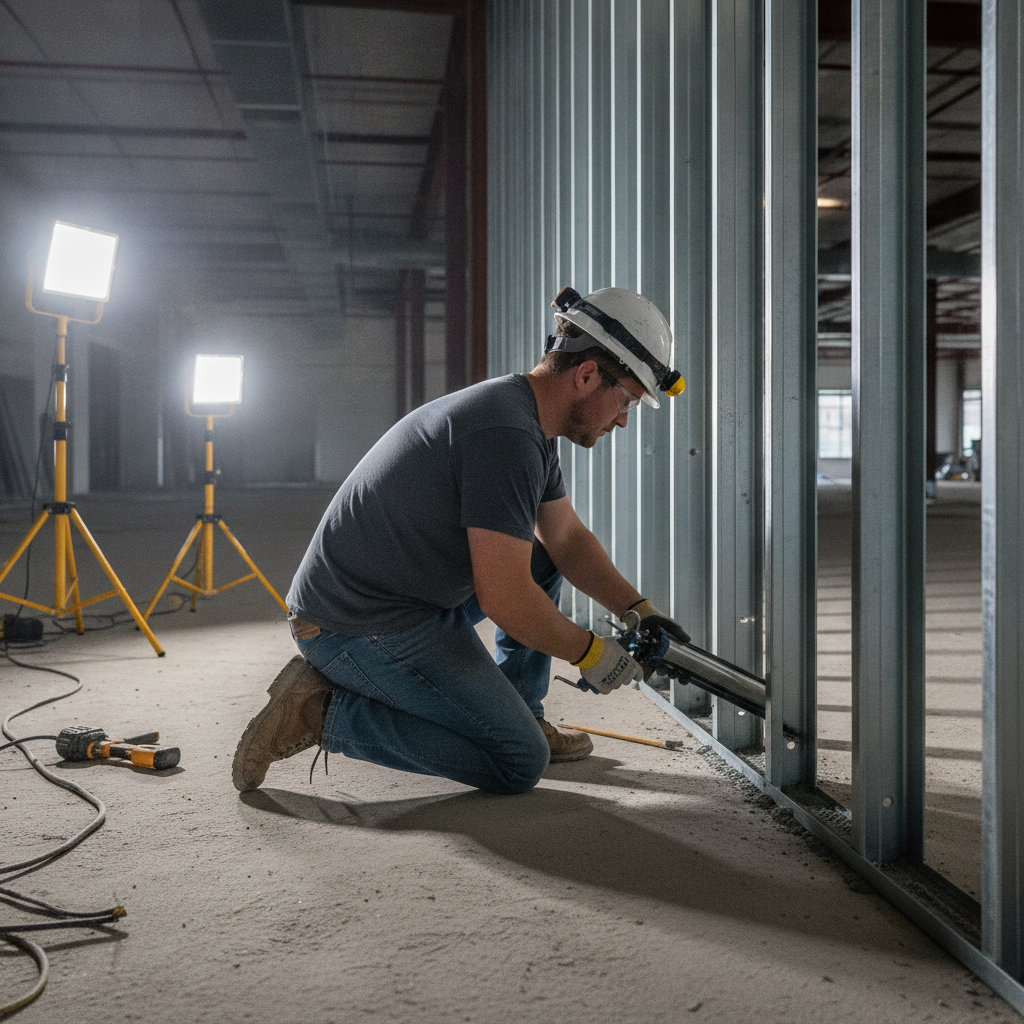
Looking for a quick framing refresher? Our stud wall basics explainer helps new team members understand why small decisions—like a single over‑long screw—can short‑circuit an entire acoustic plan.
Tools & Resources
Plan STC success with tested assemblies, detailed product data, and simple field checklists. Use resilient mounting guides, framing standards, and punchlists to verify gauge, spacing, and acoustic components work together—then confirm in the field.
- Dass Metal components: studs, standard track, deep track, slotted deflection track, resilient channel, bridging / carrying channel, furring channel, and acoustic trims (L trim, J trim, Z‑Bar).
- Installation refresher: see this step-by-step installation overview for layout, cutting, and fastening fundamentals.
- Regional framing primer: a practical framing codes overview and a contractor checklist resource to organize inspections and handoffs.
If you prefer a single package, ask us for a submittal set: assembly sketch, product list, and an on‑site checklist matched to your drawings. Our engineering team—backed by 40+ years in cold‑formed steel—can also tailor special profiles when geometry is tight.
Case Studies & Examples
Across clinics, apartments, and offices, combining mass, mineral wool, and decoupling consistently reaches STC 50+ while controlling flanking. Choose RC vs. clips vs. double studs based on space, schedule, and head-of-wall movement—then enforce airtight perimeters.
Outpatient clinic exam rooms
- Goal: speech privacy between adjacent rooms and corridor.
- Assembly: 3‑5/8 in. studs @ 16 in. o.c., mineral wool, resilient channel on exam side, double 5/8 in. Type X on the same side.
- Result: lab analogs in low‑50s STC; field within a few points with sealed perimeters and putty pads.
Multifamily corridor separation
- Goal: curb corridor chatter and door slams bleeding into suites.
- Assembly: staggered studs on 6 in. track with full‑height mineral wool; double 5/8 in. both sides.
- Result: mid‑50s STC when bulkhead flanking is closed and door gaskets align.
Office demising wall under movement
- Goal: preserve isolation at a long head‑of‑wall joint with structural drift.
- Assembly: slotted deflection track, isolation clips + 7/8 in. hat channel, mineral wool, double 5/8 in. Type X on tenant side.
- Result: high‑50s STC with reliable head movement and no fastener short‑circuiting.
We often support interiors that mix acoustic and structural needs. When a demising wall also supports built‑ins or partitions, our bridging clip, webslide clip, and windbrace solutions add restraint without over‑coupling faces—so you keep both stability and isolation.
Frequently Asked Questions
Most STC questions boil down to assembly choice, airtightness, and flanking control. The answers below give direct guidance you can put to work on your next submittal or field walk.
What STC should I target for apartment demising walls?
Target at least STC 50 in lab assemblies and about 45 in the field as a practical minimum for inter‑unit separation. You can exceed this with mineral wool, double gypsum layers, and resilient mounting to reduce callbacks and improve tenant satisfaction.
Does resilient channel really work?
Yes—when installed correctly. RC breaks the vibration path so the gypsum isn’t rigidly tied to studs. Expect 6–10 STC improvement compared with direct fastening. Maintain orientation, spacing, and screw lengths to avoid short‑circuiting.
Mineral wool vs. fiberglass—does it matter?
Both add absorption, but mineral wool typically performs more consistently across frequencies and is easier to friction‑fit. Either is far better than empty cavities. Don’t overcompress batts or you may lose some effectiveness.
How do penetrations affect STC?
Back‑to‑back boxes, unsealed pipe penetrations, and open plenum paths can drop field results by 5+ STC points. Offset boxes, use putty pads, and seal every penetration with acoustic‑rated sealant to protect performance.
Conclusion + Key Takeaways
To raise STC, upgrade more than one lever: mass, absorption, and decoupling—then seal everything. This integrated approach consistently beats single changes and helps you pass field tests with fewer surprises and fewer callbacks.
Key takeaways
- Double layers, mineral wool, and resilient mounting deliver dependable gains.
- Seal perimeters and penetrations; one missed joint can erase multiple points.
- Choose assembly types based on occupancy, wall thickness, and head movement.
- Control flanking at ceilings, bulkheads, shafts, and back‑to‑back boxes.
Next steps
- Share this guide with your framing and drywall subs.
- Call out resilient channel or isolation clips on the noisy side of each demising wall.
- Include a field checklist for perimeters, screw lengths, and penetrations.
- Ask Dass Metal for an assembly review tailored to your drawings.
Ready for a fast acoustic review? Request a submittal‑ready package with product list, gauges, and detailing notes. Our team in Vaughan supports Ontario builds and U.S. projects with certified, Canadian‑made components and on‑time delivery.