Structural framing systems are the coordinated combination of studs, tracks, channels, clips, and bracing that create a building’s load path. These systems manage gravity, wind, and movement while supporting finishes and services. Choosing the right steel stud framing strategy improves safety, schedule reliability, and finish quality across projects in the United States and Canada.
By Navjot Dass — Last updated: 2026-06-23
Start Here: Hook + Table of Contents
Use this guide to evaluate, design, and install structural framing systems with confidence. We translate engineering into field-ready steps and link to Dass Metal resources. Jump to definitions, system types, best practices, tools, and case studies you can apply immediately on your next build.
Here’s the thing: stronger frames start with clear choices. If you’re a GC, drywall/framing contractor, or architect, this guide distills what matters so you can move fast, build right, and document compliance.
- Quick summary
- What is a structural framing system?
- Why structural framing matters
- How structural framing works
- Types, methods, and approaches
- Best practices
- Tools and resources
- Case studies and examples
- Frequently asked questions
- Key takeaways
- Conclusion
Quick Summary
Structural framing systems combine cold-formed steel components and connections to carry loads and control deflection. The right pairing of studs, tracks, channels, and clips shortens schedules, improves finishes, and simplifies inspections when supported by certified manufacturing, clear submittals, and dependable delivery.
Dass Metal Products manufactures light and heavy gauge studs, tracks, channels, clips, windbracing, resilient solutions, and drywall finishing trims—all engineered for precision and supported by brochures, imperial/metric load tables, and standards. Our team collaborates with contractors and specifiers to tailor profiles, quantities, and delivery so crews stay productive.
What Is a Structural Framing System?
A structural framing system is the coordinated assembly of studs, tracks, channels, clips, and bracing that forms the building’s skeleton and load path. It distributes gravity and lateral forces to supports, manages deflection and drift, and provides a straight, stable substrate for finishes, facades, and services.
In practice, “structural” spans load-bearing and non-load-bearing assemblies. Interior partitions still need engineered control of deflection, vibration, and acoustics. Load-bearing walls, exterior cold-formed steel (CFS) framing, and shaftwall systems must also meet fire and envelope requirements alongside structural demands.
- Studs (light or heavy gauge): Primary vertical members sized by height, load, and spacing (often 16 or 24 inches on center).
- Tracks: Standard track seats studs; slotted deflection track allows vertical movement at the head; deep track increases bearing and stiffness.
- Channels: Bridging/carrying channel restrains twist; furring channel and Z-Bar manage offsets and services; resilient channel improves STC.
- Clips and connectors: Transfer forces and permit movement; examples include deflection side clips and adjustable webslide clips.
- Bracing: Strap bracing or windbrace stabilizes long runs and exterior walls prior to sheathing.
- Drywall trims and finishing sections: J trim, L trim, and cornerbeads protect edges and speed finishing.
We’ve found that early clarity on performance criteria (for example, head-of-wall movement, L/360 to L/480 deflection targets, and specific STC values) reduces rework and RFIs, keeping teams aligned from shop drawings to punch list.
Why Structural Framing Matters
The framing system sets safety, schedule, and finish quality. Proper deflection and drift control prevent cracked joints and facade damage, while certified components and documented submittals streamline inspections. Reliable delivery and custom profiles keep crews productive and sequences on track.
Here’s why framing choices ripple through the entire build:
- Risk reduction: A clear load path and appropriate deflection limits lower callbacks and warranty exposure.
- Finish quality: Movement-tolerant heads and resilient channels limit stress at gypsum joints and facade interfaces.
- Speed: Right-sized gauges, correct track selection, and preplanned bridging minimize field improvisation.
- Documentation: Submittals with load tables, MSDS, and standards simplify approvals and inspections.
- Supply assurance: Consistent availability and cross-border delivery minimize downtime in the field.
Dass Metal’s CSSBI-certified production and engineering support give specifiers and contractors confidence that assemblies will perform as designed. When timelines are tight, our ability to tailor profiles and quantities helps keep trades sequenced without idle labor or rushed substitutions.
How Structural Framing Works
Framing works by aligning studs, tracks, channels, and clips into a continuous load path with defined movement joints. Engineering sets deflection and drift criteria; fabrication delivers the correct gauges and lengths; field crews install with prescribed spacing, fastening, and bracing to achieve tested performance.
Translate the engineering into field steps your crews can follow:
- Define performance: Establish deflection criteria (common serviceability limits for gypsum include L/360; some facade zones use L/480), drift allowances at the head, fire ratings, and STC targets.
- Select members: Choose light or heavy gauge studs; decide between standard, deep, or slotted deflection track at heads; set spacing at 16 or 24 inches on center per design.
- Detail connections: Specify clips, screw sizes, and patterns (for example, 12 inches on center at tracks unless noted) and lay out bridging/carrying channel intervals.
- Document submittals: Provide brochures, imperial/metric load tables, MSDS, and any mockup references. Keep the package concise and project-specific.
- Coordinate logistics: Align deliveries by floor and elevation; label bundles by zone to cut material handling and reduce waste.
- Install and verify: Plumb studs, verify spacing, fasten per pattern, and install bridging before long runs are sheathed. Capture photos for QA.
Need a deeper dive on fundamentals? See our steel stud framing guide and this light gauge framing overview for field-ready checklists that map to these steps.
| Phase | Primary Goal | Key Actions | Outputs |
|---|---|---|---|
| Design | Define performance | Set deflection/drift, fire, STC | Basis of design notes |
| Selection | Match members to loads | Stud gauge, track type, spacing | Material list |
| Submittal | Approval and clarity | Brochures, load tables, MSDS | Approved package |
| Logistics | Reduce handling | Label by zone/floor | Sequenced deliveries |
| Installation | Build straight, build safe | Plumb, fasten, bridge | QA photos and checks |
Types, Methods, and Approaches
Most projects blend non-load-bearing interiors with load-bearing or exterior CFS assemblies. Pair studs with the right track (standard, deep, or slotted deflection), then add bridging, clips, and bracing to meet structural, acoustic, and fire requirements without overbuilding.
Non-Load-Bearing Interior Framing (Light Gauge)
Interior partitions carry their own weight and resist service loads but don’t support floors or roofs. They still require deflection control and acoustic performance.
- Typical components: Non-load-bearing studs, standard track, slotted deflection track at heads, and resilient channel for STC gains.
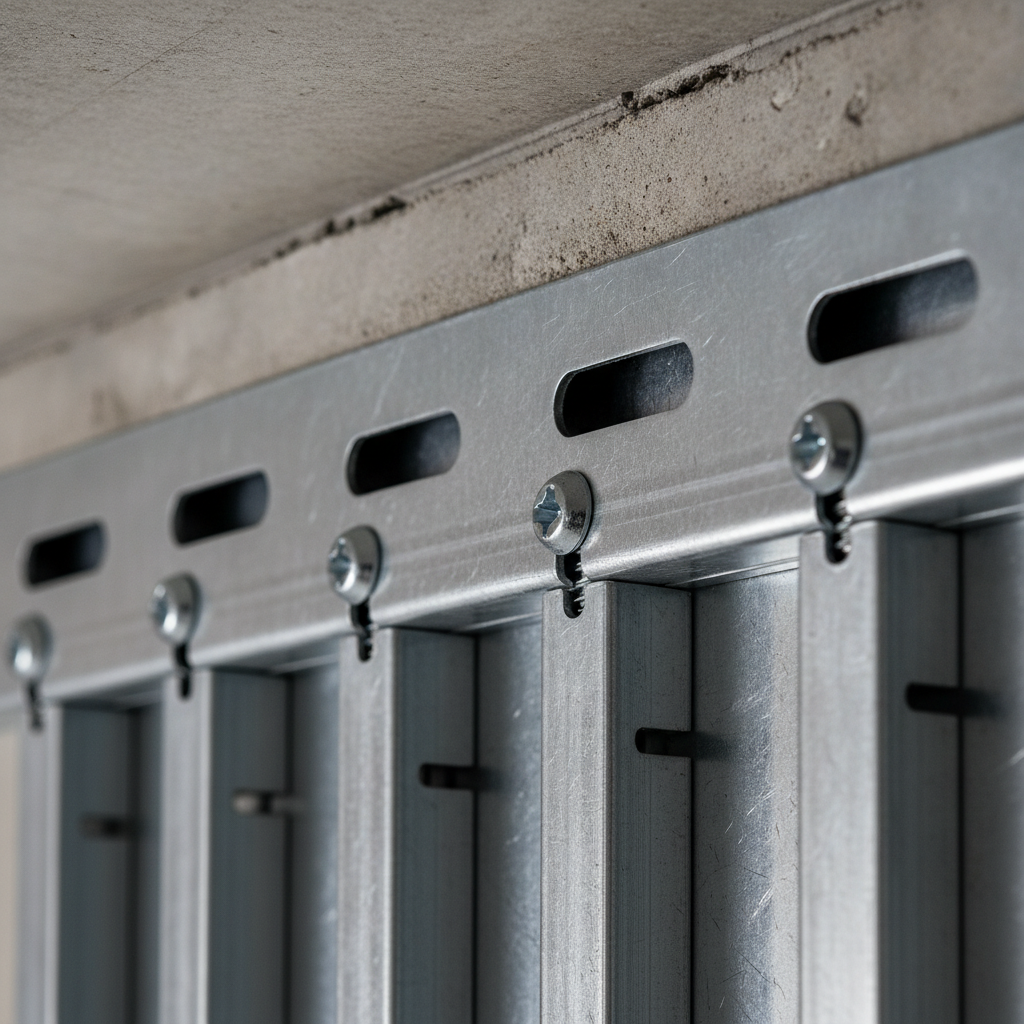
- Movement control: Slotted deflection track at the head allows vertical slab movement without crushing gypsum joints.
- Acoustics: Resilient channel decouples gypsum; furring channel and Z-Bar help manage services and offsets.
- More detail: Our steel framing systems quick guide explains member selection to hit serviceability and finish targets.
Load-Bearing Stud Framing (Heavy Gauge)
When walls carry floor or roof loads, sizing, connections, and bracing become more stringent.
- Members: Heavier-gauge studs, deep track at bases or heads, engineered clips/angles to transfer forces.
- Bracing: Bridging/carrying channel maintains stud stability; strap bracing can control lateral translation.
- Quality: Field checks focus on plumbness, screw patterns, and anchor locations; documentation supports inspections.
- Related reading: See our structural framing guide for load path and anchorage tips.
Exterior Cold-Formed Steel (CFS) Walls
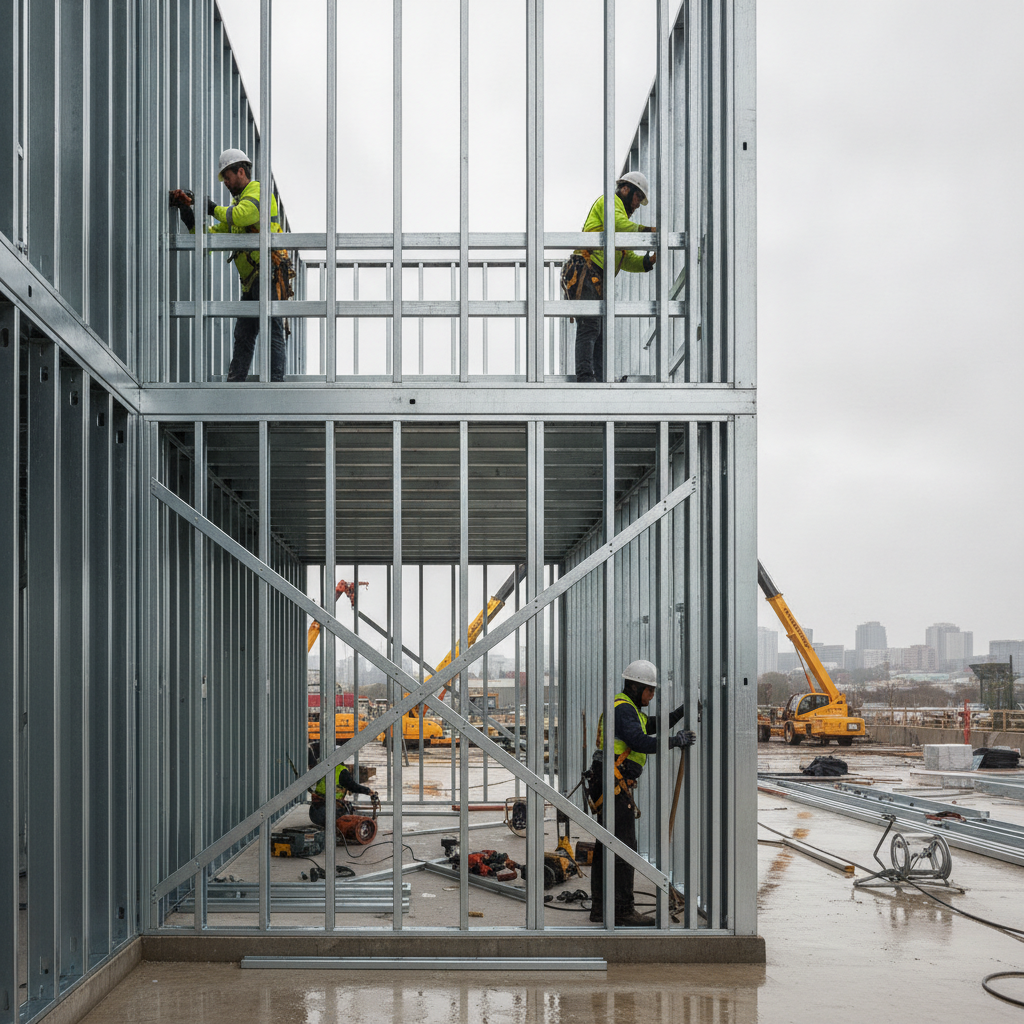
Exterior framing adds wind and envelope interface demands with strict alignment before cladding.
- Wind: Use windbrace and correct stud spans; coordinate sheathing and air/vapor barrier details.
- Movement joints: Use slotted connections at heads and control joints at cladding transitions, per design.
- Thermal: Furring channels or Z-Bar create continuous insulation planes behind facades.
- Checklist: Our metal framing systems guide outlines exterior field checks.
Shaftwall and Core Systems
Shaftwall/CH stud systems protect elevators and mechanical shafts while accommodating tolerance and fire-resistance ratings.
- Components: CH studs, matched tracks, and specialty clips; careful head-of-wall detailing.
- Interfaces: Coordinate MEP penetrations with tested seals and sleeves per design.
- Finishing: Use trims and cornerbeads (90- and 130-degree) to protect edges at access openings.
Acoustic and Specialty Assemblies
Where STC goals are specified, decoupling is essential and often faster than over-thickening gypsum.
- Resilient channel: Reduces vibration transfer; pair with insulation and sealed penetrations.
- U-Flex track: Facilitates curves without kerfing, speeding feature walls and soffits.
- Clips and connectors: Webslide and deflection side clips simplify adjustable connections at misaligned structure.
| System | Primary Goal | Key Components | When to Use |
|---|---|---|---|
| Non-Load-Bearing Interior | Finish quality, acoustics | Light-gauge studs, standard/slotted track, resilient channel | Office fit-outs, corridors, demising walls |
| Load-Bearing Walls | Carry gravity loads | Heavy-gauge studs, deep track, clips, bridging | Stairs, mechanical rooms, selected structural walls |
| Exterior CFS Walls | Resist wind, support envelope | Studs, windbrace, bridging, furring, Z-Bar | Facade framing, window walls, parapets |
| Shaftwall/Core | Fire and plumb control | CH studs, matched tracks, specialty clips | Elevators, mechanical shafts |
Best Practices
Document deflection/drift criteria, select the right head track, and sequence bridging early. Label deliveries by zone, verify screw patterns in the field, and capture photos. Certified components and tight submittals keep approvals smooth and reduce rework.
Design and Documentation
- Set criteria early: Serviceability limits like L/360 for gypsum, L/480 where needed, plus drift allowances and STC goals.
- Head-of-wall details: Use slotted deflection track where floors move relative to partitions; maintain clear slot travel.
- Submittal package: Include brochures, load tables (imperial/metric), MSDS, and any mockup notes; map product IDs to drawings.
- Coordination: Note control joints, openings, and MEP zones to avoid clashes.
Procurement and Logistics
- Right gauge, right length: Avoid field splicing by ordering optimized lengths; match gauge to span and loads.
- Bundle by sequence: Tag by floor and area; minimize double handling and stage near work faces.
- Cross-border reliability: For U.S. and Canadian jobs, confirm paperwork and delivery windows to keep trades moving.
Field Installation
- Layout and plumb: Snap lines, set base track, and verify plumbness in each bay before fastening.
- Fastener patterns: Follow specified screw sizes and spacing at tracks, clips, and bridging (for example, 12 inches on center unless noted).
- Bridging and bracing: Install bridging channel and windbrace before sheathing long runs to control alignment.
- Acoustic decoupling: Add resilient channel and furring where STC targets demand.
Quality Assurance
- Inspections: Confirm head-of-wall slots are unobstructed, screws properly seated, and anchors within tolerance.
- Photos and checklists: Tie photos to levels and zones; verify as-builts match submittals.
- Closeout: Provide product data sheets and any maintenance references for future work.
For a deeper practice library, our best-practice framework aligns details to common field conditions, cutting RFIs and punch-list churn.
Tools and Resources
Rely on brochures, load tables, standards, and MSDS to justify selections and accelerate approvals. Dass Metal’s technical library supports imperial and metric workflows, while product pages clarify where to use standard track, slotted deflection, deep track, and resilient assemblies.
Helpful references you can share with project teams:
- Overview: A primer on non-structural metal framing explains how interior partitions manage deflection and finishes.
- Product specifics: See non-load-bearing steel framing (light gauge) for studs, standard track, slotted head-of-wall solutions, and resilient options.
- Structural reinforcement: Our sister company’s rebar stirrups guide helps coordinate concrete interfaces during core and shell phases.
Need a one-pager for your submittal? Start with the steel framing systems quick guide and attach the project-specific load tables referenced in your spec.
Case Studies and Examples
These short scenarios show how component choices affect schedule and finish quality. Each pairs real-world constraints with Dass Metal solutions: tailored profiles, reliable delivery, and assemblies that control deflection, drift, and sound without overbuilding.
1) Corporate Office Fit-Out — Three Floors in Operation
Scenario: Interior reconfiguration on occupied floors. Work windows are short, and sound transfer must stay low for adjacent tenants.
- Approach: Non-load-bearing studs with slotted deflection track at heads; resilient channel on demising walls.
- Why it works: Head-of-wall movement is absorbed without damaging joints; decoupling lifts acoustic performance without excessive layers.
- Dass support: We supplied optimized stud lengths, labeled bundles by zone, and included imperial load tables and MSDS to speed approvals.
- Related reading: The light gauge framing overview includes night-shift QA checks.
2) Mid-Rise Exterior Upgrade — Wind and Envelope
Scenario: New facades on a multi-story building with variable wind exposure and continuous insulation targets.
- Approach: Exterior CFS framing with appropriately sized studs, windbrace, and bridging channel; Z-Bar/furring channel to create a continuous insulation plane.
- Why it works: Bracing maintains stud stability before sheathing; the thermal cavity supports envelope performance and straightness at cladding.
- Dass support: Engineering reviewed spans and recommended deep track where required. Deliveries were sequenced per elevation.
- Checklist: See the structural framing guide for exterior field checks.
3) Industrial Core and Shaftwall
Scenario: Elevator and mechanical shafts with stringent fire and plumb tolerances; penetrations must be coordinated early.
- Approach: CH studs with matched tracks and clips; head-of-wall slots preserved for drift; trims and cornerbeads protect edges at access openings.
- Why it works: The system handles movement while meeting fire and finish needs; coordination reduces late penetrations and patching.
- Dass support: We prepared a concise submittal bundle with standards and load tables, then aligned drop times to crane picks.
- More examples: Start with the steel stud framing guide to adapt this playbook.
4) Healthcare Suite — High STC Targets
Scenario: Imaging rooms and consult spaces call for reliable sound isolation without schedule drag.
- Approach: Non-load-bearing studs with resilient channel, sealed penetrations, and carefully staged furring for services.
- Why it works: Decoupling and air-seal discipline deliver predictable STC without overbuilding layers.
- Dass support: We coordinated deliveries by floor and provided quick-reference detail sheets for the site QA lead.
Frequently Asked Questions
Get crisp answers to common questions about structural framing systems, from deflection control to acoustic performance. Use these for training, bid clarifications, and fast field decisions.
What’s the difference between standard track and slotted deflection track?
Standard track seats studs but doesn’t allow vertical movement at the head. Slotted deflection track includes elongated slots so the structure can move without crushing gypsum finishes. Use slotted track wherever tops of walls experience slab deflection or drift.
When should I add bridging channel or windbrace?
Use bridging channel to restrain stud twist over height and improve stability; spacing is defined by engineering and member selection. Windbrace stabilizes long exterior runs against lateral forces and is typically installed before sheathing to control alignment.
How do resilient channels improve acoustics?
Resilient channels decouple gypsum from the framing, reducing vibration transfer and improving sound isolation. Pair them with insulation and sealed penetrations to meet most common STC targets in office, hospitality, and healthcare interiors.
Do I need deep track on every load-bearing wall?
Not necessarily. Deep track is used where engineering requires additional bearing, anchorage, or stiffness at the base or head of a wall. Follow the design requirements; over-specifying adds weight and complexity without benefit.
What stud spacing should I expect?
Most interior partitions use 16 or 24 inches on center, set by design requirements and finish needs. Taller walls, heavy finishes, or higher loads may require closer spacing, heavier gauges, or both. Always follow the engineer of record.
Key Takeaways
Define performance targets, choose members that match, and verify installation early. Use slotted head-of-wall details for movement, sequence bridging before sheathing, and keep submittals tight. Expect straighter walls, cleaner finishes, and fewer callbacks.
- Start with deflection, drift, fire, and acoustic goals.
- Select studs and tracks (standard, deep, slotted) with purpose.
- Plan logistics: labeled bundles by area and floor reduce waste.
- Inspect head-of-wall movement slots and screw patterns.
- Leverage certified components and concise submittals.
Conclusion
Structural framing systems succeed when engineering intent meets field clarity. With certified components, reliable delivery, and tailored profiles, Dass Metal helps teams turn drawings into durable, inspection-ready assemblies with fewer surprises and cleaner finishes.
Whether you’re building interior partitions, exterior CFS walls, or shaftwall cores, we’re ready to support specification through final inspection. Share your heights, spacing, and performance targets—we’ll translate them into submittals, takeoffs, and a delivery plan aligned to your schedule.