Drywall j bead is a J-shaped finishing trim that caps exposed gypsum edges to create crisp, paint-ready terminations and protect vulnerable board edges. It improves durability, reduces cracking at transitions, and speeds finishing. From our base in 370 New Enterprise Way, ON, Dass Metal Products supports contractors across Canada and the U.S. with reliable J trim that integrates cleanly with steel-stud framing packages.
By Navjot Dass • Last updated: 2026-05-13
Quick summary and table of contents
J bead forms a straight, durable stop wherever drywall ends or meets another finish. This complete guide explains what J bead is, when to use it, how to install it, and how to avoid common punch-list issues. Use it to standardize crisp reveals and cut edge-repair callbacks.
In this guide you’ll learn:
- What drywall J bead does and how it differs from L-bead, corner bead, and casing bead
- Where J bead belongs—and where it does not
- Step-by-step installation with field-proven QA checks
- Specification notes: profile sizing, materials, reveals, compatibility
- Mini case studies, a printable checklist, and pro tips from our teams
For broader framing context, see our metal framing systems guide to align trims with studs, tracks, and channels from day one.
What is drywall J bead?
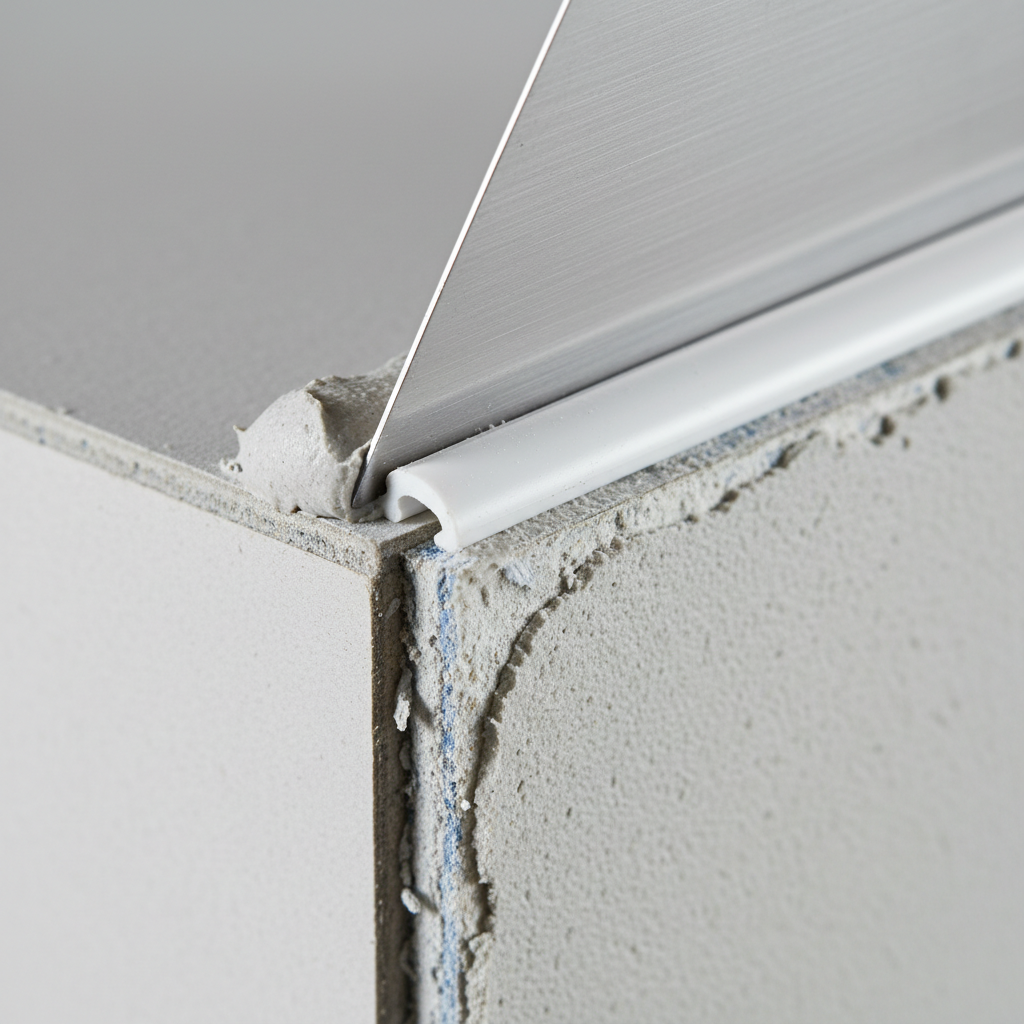
J bead (also called J trim) is a shallow, J‑shaped drywall accessory that slips over a cut gypsum board edge and presents a straight flange to the wall face. Once fastened and skimmed, it creates a chip‑resistant, paint‑ready termination for windows, doors, ceilings, soffits, and other exposed edges.
Think of J bead as a cap-and-finish profile. The return leg captures the board edge; the flange provides a consistent plane for a thin skim coat. This turns rough cuts into controlled, uniform reveals that paint cleanly—even under grazing light. Typical fits match 3/8 in., 1/2 in., and 5/8 in. drywall. Vinyl remains a favorite for its corrosion resistance and forgiving fit; galvanized steel and aluminum options suit high-impact or specialty aesthetics.
- Primary functions: cap raw edges, hide minor cut irregularities, and protect gypsum from abrasion.
- Common thicknesses: profiles sized for 3/8 in., 1/2 in., 5/8 in. board—fit matters to avoid gaps or crushing.
- Finishing approach: no tape required in most cases; apply a light skim coat over the flange and feather 6–8 in.
- Where it shines: window returns, cased openings without trim, soffit edges, access panels, and drywall-to-storefront transitions.
Our engineering team has standardized J bead details on many commercial interiors because it normalizes field variability. When you repeat a precise accessory at each opening, the result looks straighter and stays cleaner over time.
Why J bead matters on modern interiors
J bead delivers cleaner sightlines, tougher edges, and faster finishing at transitions. It prevents paint tear-out at raw gypsum, conceals rough cuts, and reduces crack risk where gypsum meets dissimilar materials. Designers also use it to form subtle shadowlines that make walls read straighter.
Edges are weak points. Uncapped gypsum can chip with casual contact, and minor waviness becomes obvious over long runs. A consistent J bead detail transforms those vulnerable ends into straight, impact-resistant terminations that hold paint and survive daily use. In our field experience, standardizing edge trims across a floor plate noticeably reduces final-touch repairs and speeds punch closure.
- Consistency: factory-straight flanges beat hand-scribed edges for uniform reveals.
- Durability: capping the edge increases abrasion resistance compared with raw gypsum.
- Speed: a thin skim over a flat flange is quicker than building out irregular edges.
- Design control: clean reveals frame openings with a contemporary look that coordinates with storefronts and millwork.
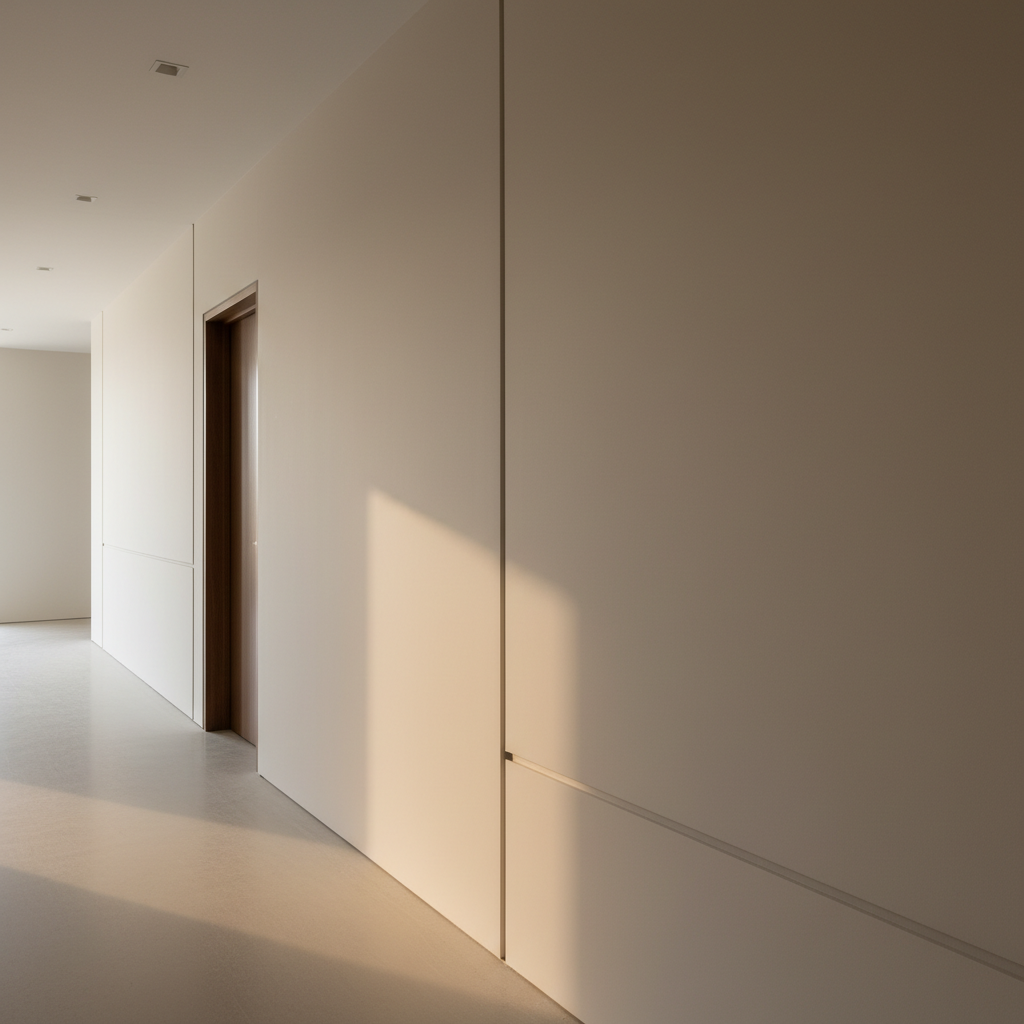
Because lighting exaggerates imperfections, especially in corridors and lobbies, we align reveal tolerances to within ±1/32 in. across openings. Small numbers, big visual difference.
How J bead works (and how it differs from other trims)
J bead caps the gypsum edge with a slip-on profile and secures its flange to the wall face by staples, screws, or adhesive. A thin skim coat feathers the flange to zero. Compared with L-bead and corner bead, J bead specifically addresses exposed edges and controlled reveals.
Here’s how common trims compare and where each excels:
| Trim | Primary use | Install style | Material | Typical reveal | Best for |
|---|---|---|---|---|---|
| J bead (J trim) | Caps raw edges | Slip over + fasten/adhesive | Vinyl or metal | Flush or 1–3 mm shadow | Window/door returns, open ends |
| L bead | Finishes abutments | Face flange only | Vinyl or metal | Feathered to zero | GWB to dissimilar surfaces |
| Corner bead | Protects corners | Crimp/screw + mud | Vinyl, steel | Rounded or chamfer | Outside corners |
| Casing bead | Defined stop edge | Fasten + plaster stop | Metal | Fixed reveal | Stucco/plaster transitions |
Functionally, J bead is your go-to whenever a raw gypsum edge is visible or when you want a uniform, intentional stop at another finish. It isn’t a replacement for movement joints or true corner protection, but it pairs well with both in a coordinated detail set. For corner protection specifics, see our notes on framing corners with metal studs.
Types, materials, and specification notes
Specify J bead by board thickness, material, flange width, and reveal intent. Match the profile to 3/8, 1/2, or 5/8 in. gypsum, select vinyl for corrosion resistance or metal for impact zones, and define flush versus subtle shadowline. Confirm primer and compound compatibility for paint adhesion.
Material choices
- Vinyl (PVC): corrosion-proof, flexible tolerance, and easy to cut. Ideal for damp areas, near storefronts, or where minor substrate variance exists.
- Galvanized steel: increased impact resistance. Ensure proper corrosion protection in humid or exterior-adjacent zones.
- Aluminum: premium, crisp look with stable geometry. Verify paint system adhesion with appropriate primer.
Profile sizing and reveals
- Order by drywall thickness—3/8, 1/2, 5/8 in.—for a snug, non-crushing fit.
- Choose flange width to match finisher skill and finish level; wider flanges are easier to feather for new crews.
- Define reveal (flush or 1–3 mm shadowline) early with design to avoid field improvisation.
Standards and finish levels
- Installation practices for gypsum board and accessories follow widely accepted gypsum association references and ASTM classifications for accessories and finishes.
- Finish levels (e.g., Level 4 or 5) influence skim thickness and inspection under raking light; align trim choice to the specified level.
- For acoustically sensitive spaces, coordinate edge trims with light gauge steel studs and resilient elements to preserve STC targets.
At Dass Metal Products, we manufacture and supply finishing sections alongside studs, tracks, channels, and clips. That integrated catalog lets project teams specify compatible components—reducing guesswork and submittal churn.
Where to use J bead (and when not to)
Use J bead where a cut gypsum edge would otherwise remain exposed: window and door returns, recessed niches, soffit edges, and drywall-to-storefront transitions. Avoid spanning expansion joints and don’t substitute J bead for true corner protection or heavy-abuse edge guards.
- Ideal placements: window/door returns, access panels, cloud ceiling perimeters, and drywall meeting frames without casing.
- Use L-bead instead: at abutments where the gypsum edge is not exposed and you want a feathered zero-reveal transition.
- Use corner protection: on outside corners that need impact resistance—consider a 90°/130° corner bead in these locations.
- Movement joints: never bridge them with J bead; specify dedicated joint trims and respect gap requirements.
On multifamily corridors and healthcare suites, we standardize J bead around access openings to keep reveals straight under bright linear lighting. Consistent terminations also speed repaint cycles because edges don’t fray with routine cleaning.
How to install J bead: a field-tested process
Cut to length, dry-fit the profile to confirm reveal, then secure with staples, screws, or adhesive per the trim material. Keep fasteners 8–12 in. on center, maintain a flat flange, apply a thin skim coat feathered 6–8 in., sand lightly, prime, and finish paint.
- Measure and verify fit: confirm board thickness matches the profile (3/8, 1/2, or 5/8 in.).
- Cut clean: use aviation snips for metal or shears/utility knife for vinyl; deburr ends to avoid telegraphing.
- Dry-fit and align: slip the J over the gypsum edge and check reveal continuity at corners and frames.
- Fasten: staple or screw 8–12 in. o.c.; for vinyl, approved adhesives can reduce fastener telegraphing—follow the manufacturer’s guidance.
- Skim light: apply a thin coat over the flange and feather 6–8 in.; avoid building a ridge.
- Sand and inspect: use a flat sanding block; inspect under grazing light to catch waves early.
- Prime and paint: use a primer compatible with vinyl or metal; test adhesion on an offcut before full application.
Related method detail: see how we install metal corner beads to compare fastening patterns and finish sequences.
Soft CTA: Standardize your edge terminations and submittals with our J trim catalog—visit the Dass Metal J Trim page and coordinate profiles with your stud and track schedule.
Quality checks, tolerances, and common mistakes
Hold reveals to a consistent datum, typically within ±1/32 in. across an opening. Keep fasteners 3/8 in. from edges and 8–12 in. on center. Most callbacks stem from loose fit on the board edge, over-mudding the flange, or skipping primer compatibility tests.
- Reveal control: snap a chalk line and use shims at rough bucks to maintain straightness on long runs.
- Fastener placement: don’t crush the flange; maintain edge distances and consistent spacing.
- Compound thickness: if the flange disappears under the first pass, you’re likely overbuilding—keep it thin.
- Primer and paint: verify adhesion over vinyl with the exact primer/topcoat system specified.
- Movement allowance: never cross control or expansion joints with rigid trims.
To reduce wave risk, we back-block weak edges near doors so slam loads don’t telegraph through the finish. For more system-level tips, review our guidance on avoiding drywall framing mistakes before crews start closing walls.
Tools, coordination, and submittal resources
Crews need snips or shears, a 6–10 in. knife, sanding block, and a stapler or screw gun; vinyl-friendly adhesive is optional. Submittals should include product sheets, SDS, and referenced standards, plus a short sample for architect approval and mockup notes.
Field tools
- Vinyl shears or aviation snips
- 6–10 in. taping knife with pan/hawk
- Stapler or collated screw gun
- Fine-grit sanding block and raking light
- Solvent-safe primer compatible with vinyl or metal trims
Coordination tips
- Bundle trims with studs and tracks to avoid site delays—coordinate with your light gauge steel studs and 16 gauge metal studs takeoffs.
- Where floors move under structure, specify slotted deflection track above walls and stops to prevent cracking at ceilings.
- Choose one primer and joint-compound system across all units to minimize flashing differences at reveals.
Spec and submittal package
- Product brochure and profile cut sheet for J trim
- SDS and quality certification documentation
- Referenced gypsum installation practices and finish level definitions
- Mockup notes and acceptance criteria
Because Dass Metal Products manufactures and supplies both framing and finishing components, our teams help align profile availability with schedules and packaging—keeping crews productive and walls closing on time.
Mini case studies and field examples
Across multi-unit residential, office, and healthcare interiors, standardizing J bead on window returns, access openings, and ceiling transitions shortens finishing cycles and reduces touch-ups. Consistent reveals also meet modern design intent without custom millwork.
Example 1: Mid-rise residential corridors — We detailed vinyl J bead around dozens of access panels. Under bright corridor lighting, edges tracked straight and paint crews finished in fewer passes. Callbacks for edge repairs dropped notably floor-to-floor.
Example 2: Healthcare reception — J bead terminated drywall neatly to a millwork desk and storefront frame. The capped edge resisted nightly cleaning abrasion and kept the joint line from chipping.
Example 3: Office window returns — Subtle 2 mm shadowlines around glazing frames elevated the design without adding custom trim. Reveals remained within ±1/32 in. after punch, reducing rework.
On projects where structure-to-partition movement is expected, we pair J bead terminations with deflection tracks and appropriate clips to maintain both the aesthetic and the building’s movement allowance.
Printable checklist: J bead installation QA
Verify profile match, straight reveals, proper fastening, light skim, and primer compatibility. Inspect under grazing light at three milestones: after dry-fit, after first coat, and before final paint. Document acceptance with photos against your mockup.
- Profile matches board thickness (3/8, 1/2, 5/8 in.)
- Reveals aligned to a snapped datum; tolerance ±1/32 in. at openings
- Fasteners 8–12 in. o.c., 3/8 in. from trim edges; no flange crush
- Skim coat thin, feathered 6–8 in.; no ridges or waves
- Primer and topcoat compatibility confirmed on offcuts
- Final check under raking light; address telegraphing early
Local considerations for 370 New Enterprise Way
- Seasonal humidity swings can highlight reveals; standardize primer and compound systems across units to minimize flashing.
- Winter timelines compress finishing windows; schedule bead deliveries with framing packages so crews don’t idle between hang and mud.
- In high-traffic Vaughan-area commercial spaces, specify J bead around access panels to reduce maintenance touch-ups across service cycles.
Drywall J bead: Frequently asked questions
Here are direct answers to the most common J bead questions from contractors and designers—covering fit, when to use L-bead, finishing tips, and paint over vinyl. Each answer reflects field practice and widely accepted installation references.
Where should I use J bead instead of L-bead?
Use J bead when the drywall edge is exposed and needs a protective cap—window returns, door frames without casing, soffits, and access panels. Use L-bead at abutments where the gypsum edge is not exposed and you want a feathered, flush transition to another surface.
Do I need tape over the J bead flange?
No. Most J bead installations require only a light skim coat over the flange. Keep compound thin and feather 6–8 inches. Overbuilding causes extra sanding and can telegraph waves through finish paint. Follow the trim manufacturer’s instructions and your project’s finish level.
Will paint adhere to vinyl J bead?
Yes, with compatible primers. Scuff-sand lightly if recommended and use a primer suitable for vinyl or plastic substrates. Always test on an offcut to confirm adhesion with the exact paint system specified for your project.
What size J bead fits 5/8-inch drywall?
Select a profile labeled for 5/8-inch board so the return leg captures the edge snugly without crushing. A mismatch leads to visible gaps or compression that show under raking light after paint.
Can J bead bridge movement joints?
No. Do not bridge expansion or control joints with J bead. Use purpose-built movement joint trims or leave properly detailed gaps per the drawings. Bridging joints can cause cracking and jeopardize warranties.
Conclusion and next steps
J bead is the simplest way to turn vulnerable drywall edges into crisp, durable terminations. Specify the right material and fit, install with a light touch and straight reveals, and prime for compatibility. You’ll accelerate finishing, elevate appearance, and reduce callbacks.
Want to lock in a repeatable edge detail on your next project? Coordinate J trim with studs, tracks, and channels at takeoff. Our team in 370 New Enterprise Way supports Canadian and U.S. projects with engineered profiles and dependable delivery, so your crews keep moving from hang to paint.
Key takeaways
Match the profile to drywall thickness, keep reveals straight, fasten correctly, skim thin, and verify primer compatibility. Use J bead for exposed edges; choose L-bead or corner bead where appropriate. Integrate trims with your broader steel-stud and track package.
- J bead caps raw drywall edges for straight, paint-ready terminations.
- Control reveals to ±1/32 in. and maintain 8–12 in. fastener spacing.
- Skim lightly; overbuilding telegraphs through paint under grazing light.
- Don’t bridge movement joints; use dedicated trims where required.
- Bundle trims with studs, tracks, and channels to keep schedules on track.