C stud dimensions refer to the web width, flange depth, and return (lip) of cold-formed steel studs, plus thickness expressed in gauge or mils. Typical web widths run 1-5/8 to 6 inches with 1-1/4 or 1-5/8 inch flanges. Getting dimensions right protects capacity, wall thickness, and compatibility with tracks and accessories.
By Navjot Dass • Last updated: June 25, 2026
Why this guide matters
This guide turns “C stud dimensions” into clear, job-ready steps. You’ll learn how to read web, flange, and lip sizes, choose the right thickness, and match studs to tracks, clips, and channels. Use the checklists, tables, and examples to prevent rework, RFIs, and on-site delays.
- Understand web, flange, lip, and thickness (gauge/mil) in minutes
- See the most common widths and how they map to wall assemblies
- Match studs to tracks, deflection, bridging, and acoustic needs
- Avoid ordering errors with a one-page submittal checklist
- Learn how Dass Metal supports Canada- and US-wide projects
At a Glance
- Common web widths: 1-5/8, 2-1/2, 3-5/8, 4, 6 inches
- Common flange depths: 1-1/4, 1-3/8, 1-5/8 inches
- Typical returns (lips): 3/16 to 3/8 inch
- Typical thicknesses (non-structural to structural): 25ga to 16ga (≈ 18–54 mil)
- Common spacing: 16 or 24 inches on center
Table of contents
What are C stud dimensions?
C stud dimensions are the three core geometry values of a cold-formed steel stud—web, flange, and lip (return)—plus material thickness. Web sets the wall cavity width, flanges define fastening and stiffness, and the lip stabilizes the flange. Thickness (gauge or mil) drives capacity, screw pullout, and serviceability.
A C-shaped steel stud has a flat web with two flanges and small lips. Each element plays a role in stiffness, screw engagement, and compatibility with tracks and accessories. When you select dimensions, you’re choosing performance, installation speed, and long-term durability.
- Web (W): The stud’s “width.” Typical webs: 1-5/8, 2-1/2, 3-5/8, 4, 6 inches.
- Flange (F): The leg you fasten through. Common flanges: 1-1/4, 1-3/8, 1-5/8 inches.
- Lip/Return (R): Small turn-in to stabilize the flange, often 3/16–3/8 inch.
- Thickness: Expressed as gauge (e.g., 25, 20, 18, 16) or mil (e.g., 18, 30, 43, 54).
Because wall finishes, MEP routing, and acoustic goals compete for space, your first decision is cavity width (web). Then pick flange(s) that balance screw bite, stiffness, and detail clearances. Finally, choose thickness for the wall’s height, loading, and deflection needs.
New to steel sizes? Our quick explainer on steel stud size breaks down nomenclature and conversions contractors see in submittals.
Why C stud dimensions matter
Selecting the right C stud dimensions protects structural capacity, finish quality, and schedule. Web controls wall thickness and MEP routing; flange and lip affect screw bite and lateral stiffness; thickness governs height limits and deflection. The right combination prevents bowing, screw pops, and costly rework.
Dimensions are not just catalog numbers—they’re design levers. Web width fixes cavity space for insulation, plumbing, and electrical. Flange depth changes stiffness and fastener edge distances. Thickness affects vertical capacity and serviceability (how much a wall moves under load).
- Finish flatness: Insufficient stiffness can telegraph waves through drywall.
- Height and loads: Taller partitions or load-bearing walls demand heavier thickness (e.g., 43–54 mil).
- Acoustics: Wider cavities and resilient channels help decouple finishes for better STC.
- MEP: A 3-5/8 or 6 inch web can simplify rough-ins compared to 2-1/2.
On mixed-use projects, we often see 3-5/8 inch studs at 16 inches on center for high-traffic corridors because they balance stiffness and space. For shaftwalls and tall lobbies, heavier-gauge studs or CH/shaftwall profiles maintain alignment and life-safety performance.
To compare framing layouts, review our field-tested primer on metal stud framing sizes and common on-center patterns.
How to measure and specify a C stud
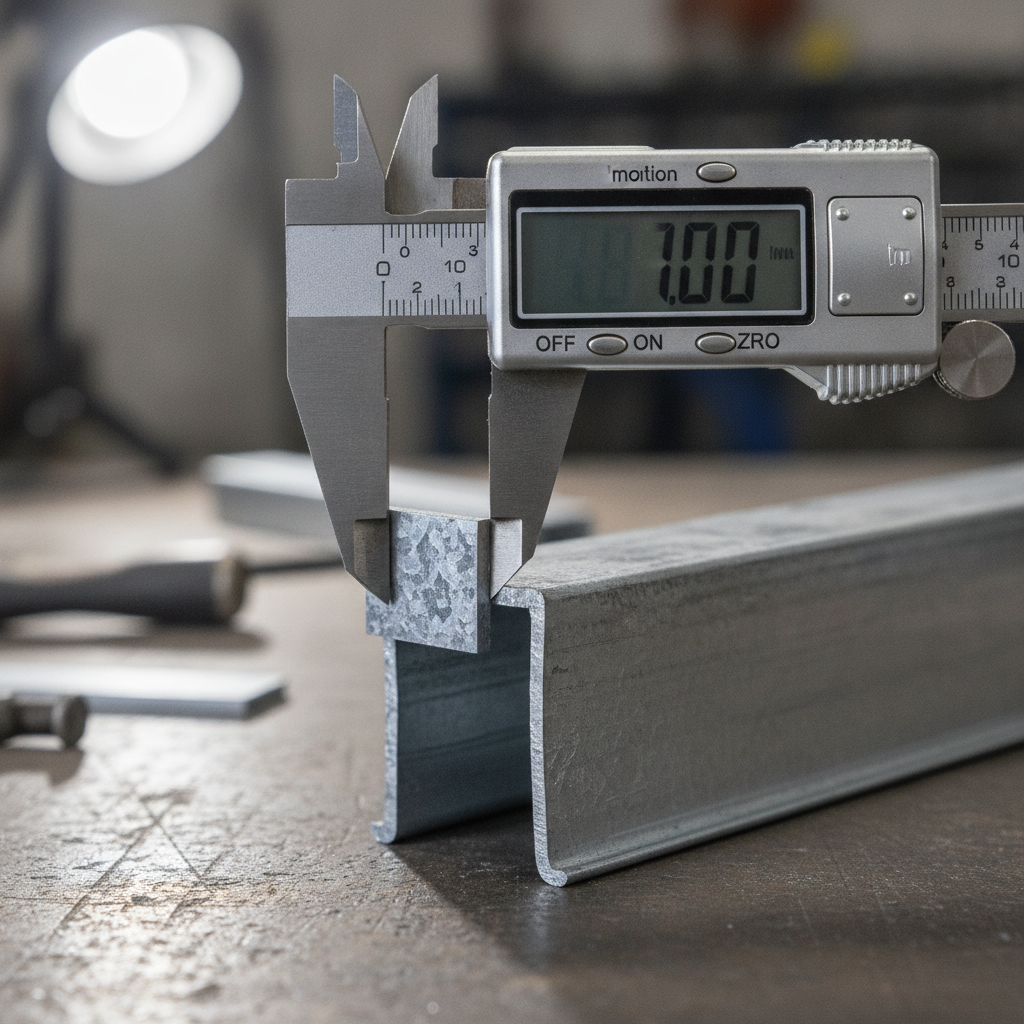
Measure the web, flange, and lip with a tape or calipers, then confirm thickness with a mil gauge or manufacturer tables. Specify a stud by web x flange x thickness (mil) with coating, yield strength, and on-center spacing, plus matching track and required clips, channels, or deflection components.
In submittals and purchase orders, clarity prevents rework. We recommend listing the geometry and performance inputs together so procurement, site crews, and inspectors see the same numbers.
- Record geometry: Web (in), flange (in), lip (in).
- Confirm thickness: Gauge and mil (e.g., 20ga ≈ 30 mil).
- State strength: Specify yield strength when required.
- Set spacing: 16 or 24 in o.c. are most common.
- Match tracks: Track type (standard, slotted deflection, deep).
- Detail accessories: Bridging channel, resilient channel, clips/anchors.
- Reference drawings: Partition types, heights, and any live/dead load inputs.
Need a quick overview of light-gauge options before you spec? See our guide to light gauge steel studs and where they fit.
Common sizes and profiles
C stud sizes center around a few web widths—1-5/8, 2-1/2, 3-5/8, 4, and 6 inches—with flanges of 1-1/4 to 1-5/8 inches and lips of 3/16 to 3/8 inch. Non-structural studs typically use 25–20 gauge; structural and tall walls often require 18–16 gauge or CH/shaftwall profiles.
Most-used C stud dimensions
- 1-5/8 inch web: Light partitions, furring, and tight chases.
- 2-1/2 inch web: Slim walls where MEP is minimal; great for small offices.
- 3-5/8 inch web: The “workhorse” for commercial interiors; balances space and stiffness.
- 4 inch web: Extra room for services or insulation upgrades.
- 6 inch web: Tall partitions, larger chases, and higher STC assemblies.
Flanges and lips
- Flange: 1-1/4, 1-3/8, or 1-5/8 inches, chosen for screw bite and lateral stability.
- Lip: 3/16 to 3/8 inch typical; stabilizes the flange to reduce twist.
Thickness and use cases
- 25–20 gauge (≈ 18–33 mil): Non-structural drywall partitions and soffits.
- 18–16 gauge (≈ 43–54 mil): Tall walls, load-bearing lines, and high load applications.
- CH/Shaftwall studs: For elevator/stair shafts and rated assemblies.
| Typical Web (in) | Common Flange (in) | Lip (in) | Typical Thickness | Typical Use |
|---|---|---|---|---|
| 1-5/8 | 1-1/4 | 3/16–1/4 | 25–20ga | Furring, short partitions |
| 2-1/2 | 1-1/4 or 1-3/8 | 1/4–5/16 | 25–20ga | Light interior partitions |
| 3-5/8 | 1-1/4 or 1-5/8 | 1/4–3/8 | 25–18ga | Core commercial walls |
| 4 | 1-3/8 or 1-5/8 | 1/4–3/8 | 25–18ga | Added services/insulation |
| 6 | 1-5/8 | 5/16–3/8 | 20–16ga | Tall or high-demand walls |
For a deeper dive on framing layouts and size ranges, bookmark our all-in-one metal stud framing guide.
Best practices and field tips
Treat C stud dimensions as a system decision. Match stud width to cavity needs, flange to screw bite and lateral stiffness, and thickness to height and load. Confirm tracks, bridging, and deflection details before ordering. Document everything in a single submittal page to avoid change orders.
Dimension selection checklist
- Confirm partition type and required ratings.
- Set cavity width for MEP and insulation (web).
- Pick flange depth for screw bite and stiffness.
- Choose thickness for height, spacing, and loads.
- Specify track: standard, deep, or slotted deflection.
- Add bridging channel and resilient channel where required.
- List clips (deflection, webslide, bridging) and anchors.
- Note coating and any yield strength requirements.
Coordination moves that save weeks
- Hold a quick BIM/coordination review when switching from 2-1/2 to 3-5/8 inch webs—door frames, MEP, and ceilings are affected.
- Confirm head-of-wall deflection details early; it changes track type and clip counts.
- Standardize on two flange depths across the project to simplify screws and training.
When in doubt, preassemble knowledge
- Print a one-page sizing sheet for supers and buyers.
- Keep a mil gauge in foremen’s kits to verify thickness on delivery.
- Use sample bays to lock in spacing (16 vs 24 in o.c.) before full production.
Tools, resources, and submittals
Use calipers or a tape for web/flange, a mil gauge for thickness, and manufacturer load tables for height and spacing. Organize submittals with geometry, thickness, spacing, track type, clips, and channels on one page so buyers and supers align on the same dimensions and components.
Starting toolkit for layout and QA/QC:
- Calipers or tape to capture web and flange values.
- Mil gauge for quick thickness verification on site.
- Stud finder + laser for layout checks at 16 or 24 inches o.c.
- Load/deflection tables from the manufacturer for height limits.
- Accessory datasheets for clips, channels, and tracks.
New to cold-formed framing? Our overview on cold-formed steel framing aligns terms like web, flange, track, and bracing with real jobsite photos.

Submittal template (one page)
- Stud: Web x Flange x Lip, Thickness (gauge/mil), Yield, Coating
- Spacing: 16 or 24 in o.c., Height and unsupported lengths
- Track: Standard / Deep / Slotted Deflection
- Bracing: Bridging channel, straps, or windbrace if applicable
- Acoustic: Resilient channel (single/double), insulation type
- Clips/Anchors: Deflection side clip, webslide clip, bridging clip
- Notes: Doors, openings, headers, jamb studs, backing, blocking
For hands-on techniques, see this practical field piece on how to use steel studs for consistent results.
Case examples
These quick scenarios show how changing a single C stud dimension shifts constructability and performance. We adjust web, flange, and thickness to meet height, MEP, acoustic, and deflection constraints while keeping components compatible with tracks, clips, and channels.
1) Tight chase, heavy traffic
- Challenge: Corridor return needs slim walls but durable finishes.
- Dimensions: 2-1/2 inch web, 1-5/8 inch flange, 20ga at 16 in o.c.
- Accessories: Standard track, bridging channel at mid-height.
- Why it works: Keeps the wall thin without sacrificing screw bite.
2) Mixed-use core wall (taller span)
- Challenge: Taller lobby wall experiences footfall vibration.
- Dimensions: 3-5/8 inch web, 1-5/8 inch flange, 18ga.
- Accessories: Deep track at base, slotted deflection track at head.
- Why it works: Heavier gauge controls deflection; slotted head protects finishes.
3) High-STC partition near theater
- Challenge: Elevated acoustic targets next to performance space.
- Dimensions: 6 inch web, 1-5/8 inch flange, 20ga at 24 in o.c.
- Accessories: Resilient channel, insulation, and careful outlet layout.
- Why it works: Bigger cavity enables decoupling and thicker insulation layers.
4) Shaftwall alignment
- Challenge: Elevator shaft requires rated studs and exact alignment.
- Dimensions: CH/shaftwall stud profile sized to system load tables.
- Accessories: J-track and system-specific head details.
- Why it works: The profile is engineered for rated shaft assemblies with repeatable details.
Explore our product overview for steel studs if you’re standardizing partitions across multiple floors.
Frequently Asked Questions
C stud dimensions come down to web, flange, lip, and thickness. Most interiors use 2-1/2 or 3-5/8 inch webs with 1-1/4 or 1-5/8 inch flanges at 16 or 24 inches o.c. Choose heavier gauges for taller spans, rated walls, or higher loading, and match tracks and clips accordingly.
What do the numbers on a C stud mean?
They describe geometry and thickness. A common notation is web × flange × thickness (mil) with a lip/return. For example, 3-5/8 × 1-1/4 × 33 mil indicates a 3-5/8 inch web, 1-1/4 inch flange, and about 20 gauge thickness.
What flange depth should I pick?
Pick 1-1/4 inch flanges for space efficiency and 1-5/8 inch flanges for added lateral stiffness and easier screw placement. Confirm your corner, backing, and trim details so the flange doesn’t crowd accessories or finishes.
How do I match studs to tracks?
Track web typically equals the stud web. Choose standard track for fixed heads, deep track for added tolerance, and slotted deflection track when the head must move under structure drift or live load. Align coating and thickness with the studs.
Do I need bridging or resilient channel?
Use bridging to control stud twist and buckling, especially in taller spans. Add resilient channel to improve acoustics by decoupling drywall from studs. Both components should be coordinated in the drawings and listed in submittals.
When should I move from 2-1/2 to 3-5/8 inch webs?
Switch when you need more MEP space, higher stiffness, or taller spans without jumping immediately to heavier thicknesses. 3-5/8 inch webs are common in corridors and multi-tenant fit-outs because they balance cavity space with finish quality.
Key takeaways and next steps
Choose C stud dimensions by aligning web width with cavity needs, flange with stiffness and screw bite, and thickness with height and loading. Confirm tracks, channels, and clips in one-page submittals. If anything’s unclear, get a quick engineering review before ordering to avoid delays.
- Web = cavity; flange = stiffness; thickness = capacity.
- Standardize flange depths and spacing to streamline training and QC.
- Lock in head-of-wall details early to pick the right track.
- Use bridging and resilient channels where spans or acoustics demand.
Want a quick orientation before placing orders? Start with our primer on framing sizes, then review the all-in-one steel studs guide.
For code-focused readers, this overview of basement framing rules gives practical context to head-of-wall decisions: see framing rules in practice. For concrete interfaces, two primers on rebar and detailing are helpful background: foundation wall rebar details and ASTM A706 guide.