Steel building studs are cold-formed, galvanized steel members used to frame interior and exterior walls, floors, and ceilings. They deliver straight, non-combustible, code-compliant framing that stays dimensionally stable across seasons. For contractors around 370 New Enterprise Way in Vaughan, specifying steel building studs from Dass Metal ensures consistent quality and reliable delivery across the Regional Municipality of York.
By Navjot Dass — Dass Metal Products
Last updated: 2026-06-19
Summary
This guide explains what steel building studs are, why they matter, how to frame with them, and which profiles to choose. You’ll learn best practices for codes, acoustic and deflection control, and submittals. Real project examples show how Dass Metal supports fast, precise installs in Ontario and across the U.S.
Use this complete, practical guide to plan clean, code-ready framing with fewer call-backs. You’ll quickly find:
- Definitions, standards, and the anatomy of studs and tracks
- Benefits vs wood: fire, moisture, straightness, and schedule control
- How steel stud framing works from layout to close-up
- Types: non-load-bearing, load-bearing, shaftwall, channels, clips
- Best practices for deflection, acoustics, corrosion, and fastening
- Submittals: load tables, MSDS/SDS, shop drawings, and QA checklists
- Local tips for staging and delivery around Vaughan and York Region
Table of contents
- What are steel building studs?
- Why steel studs matter in 2026
- How steel stud framing works
- Types of studs, tracks, channels, and clips
- Best practices, codes, and coordination
- Tools, resources, and templates
- Building with steel studs in Vaughan & York Region
- Case studies and real-world examples
- Frequently Asked Questions
- Key takeaways
- Conclusion
What are steel building studs?
Steel building studs are cold-formed, C-shaped steel members paired with U-shaped tracks to create walls and ceilings. Manufactured from galvanized coil, they provide predictable strength, dimensional stability, and non-combustibility for interior and exterior framing in commercial, institutional, and multifamily buildings.
At their core, steel studs are precision-rolled from coated coil into consistent profiles. Common nominal thicknesses include 18 mil (approx. 25 ga), 30 mil (20 ga), 43 mil (18 ga), 54 mil (16 ga), and 68 mil (14 ga). Typical yield strengths range from 33 to 80 ksi depending on specification and application, supporting both non-structural and structural needs.
Stud anatomy and terms
- Web: The broad face where services can run; also the dimension that determines stud depth (e.g., 3-5/8 in., 6 in.).
- Flanges: The legs of the C-shape that provide screw face for drywall and sheathing; often with stiffening lips for rigidity.
- Tracks: U-shaped members that receive studs at head and base; options include standard, deep, and slotted (for deflection).
For deeper background on profile basics and common dimensions, see our in-depth metal stud framing sizes overview, which outlines practical stud depths and flange widths used across interior and exterior assemblies.
Materials and coatings
- Galvanized (zinc) coating protects against corrosion. Coating weights are chosen for the environment, with heavier coatings for moisture-prone areas and exterior sheathing zones.
- Cold-formed steel delivers high strength-to-weight ratio, enabling tall walls and long spans with lighter members and efficient bracing.
If you’re comparing framing options, our steel vs wood framing guide breaks down fire, moisture, and straightness considerations that often influence schedules and finishes.
Why steel studs matter in 2026
Steel studs improve schedule reliability, safety, and long-term performance. They arrive straight, resist fire and mold, support acoustic targets with resilient channels, and pair with slotted tracks for seismic and live-load deflection—reducing rework and enabling consistent quality at scale.
Here’s the thing: straight, uniform framing reduces finishing time and punch-list friction. Steel is non-combustible and does not warp or shrink, which helps keep door frames square and drywall joints tight over time. In our experience, crews close walls sooner when the framing planes flat and fasteners bite consistently.
- Dimensional stability: No seasonal shrink-swell; fewer popped screws and cracks at joints.
- Fire and moisture resilience: Non-combustible base material and zinc coating for corrosion resistance in interior dry service conditions.
- Predictable strength: Published section properties and load tables streamline engineering and submittals.
- Acoustic control: Use resilient channel, insulation, and staggered layouts to reach common STC goals in multifamily and healthcare.
When you need structural capacity, heavy-gauge members in a load-bearing configuration carry axial and lateral loads effectively. Explore our product-level details for load-bearing stud framing (heavy gauge) to understand when to step up in thickness and how to coordinate bracing.
How steel stud framing works
Steel stud framing follows a repeatable process: layout, anchor track, plumb and insert studs, bridge and brace, then sheath and finish. QA checks verify spacing, screw patterns, and required deflection gaps at the head. This workflow improves speed while protecting code compliance and finish quality.
- Layout: Snap lines for track and locate openings. Standard spacing is 16 in. or 24 in. on-center as specified.
- Anchor track: Fasten base and head track; use slotted deflection track where structure expects movement.
- Place studs: Cut to height, seat fully in track, and orient flanges correctly for sheathing.
- Fasten: Use the correct self-drilling screws and patterns (e.g., 12 in. o.c. unless otherwise noted).
- Bridge and brace: Install bridging/carrying channel and compression posts per design; add windbrace on exterior walls as required.
- Rough-in and close: Coordinate MEP penetrations with hole locations; install sheathing and drywall with the right screw lengths and spacing.
For a step-by-step view of interior partitions, see our interior stud wall framing process reference, which maps common details (stud spacing, blocking, and head-of-wall) to field checks.
Quality checks that prevent rework
- Head-of-wall movement: Maintain the specified gap (often 1/2–1 in.) at slotted deflection tracks; don’t hard-fasten studs to structure where slip is required.
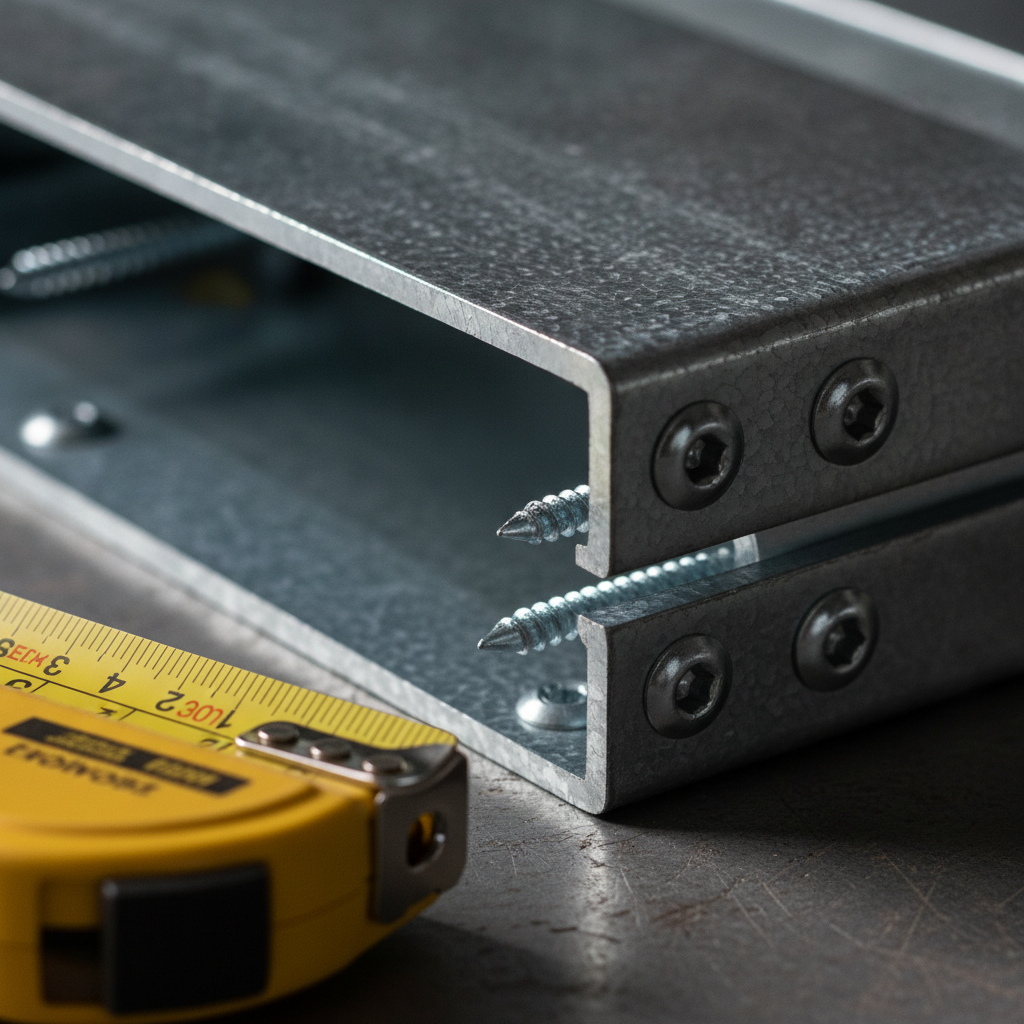
- Screw type and edge distances: Verify #6 or #8 self-drilling screws and minimum 3/8 in. edge distances to prevent tear-outs.
- Stud plumb and crown: Check with a 4-ft. level; flip any crowned members to keep the face plane true.
- Bridging frequency: Install bridging/carrying channel at designed intervals to control weak-axis buckling.
Looking for a condensed checklist? Our metal studs guide distills screw schedules, bridging intervals, and common tolerances into a single, field-friendly reference.
Types of studs, tracks, channels, and clips
Choose profiles based on load, height, and performance. Light-gauge studs frame non-load-bearing walls; heavy-gauge members handle axial and lateral loads. Tracks guide studs, with deep and slotted options for tall walls and deflection. Channels, clips, and braces add stiffness, alignment, and seismic movement control.
Core wall members
- Non-load-bearing studs (light gauge): Common in 25–20 ga for interior partitions, soffits, and furring. For fundamentals and common mistakes to avoid, visit our light gauge steel studs explainer.
- Load-bearing stud framing (heavy gauge): 18–14 ga for structural walls and tall exterior systems; see heavy-gauge framing system to understand detailing requirements.
- Standard track: U-shaped receiver for head and base conditions in typical partitions.
- Deep track: Extra leg depth for tall walls and added tolerance where substrates vary.
- Slotted deflection track: Slots accommodate vertical movement from live load or seismic drift without sacrificing wall integrity.
Alignment and performance accessories
- Bridging/carrying channel: Ties studs together to reduce weak-axis buckling on tall walls.
- Resilient channel: Decouples drywall to boost STC ratings in multifamily, healthcare, and education projects.
- Windbrace: Diagonal bracing to help resist lateral loads on exterior walls and parapets.
- U-Flex track: Curvable track for radiused walls and design accents.
- Furring channel: Levels surfaces and creates service cavities for MEP and acoustics.
- Clips: Deflection side clips, webslide clips, and bridging clips speed installs and maintain critical clearances.
| Profile | Typical thickness | Primary use | Notes |
|---|---|---|---|
| Light-gauge studs | 18–30 mil (25–20 ga) | Interior non-structural walls | Fast, straight partitions and soffits |
| Heavy-gauge studs | 43–68 mil (18–14 ga) | Load-bearing, tall walls | Engineer with published section properties |
| Slotted deflection track | Matches stud gauge | Head-of-wall movement | Prevents hard connection to structure |
| Deep track | Matches stud gauge | Tall or misaligned substrates | Adds tolerance and bearing length |
| Resilient channel | 25–20 ga | Acoustic separation | Improves STC when detailed correctly |
If you’re specifying sizes, our quick reference on stud framing sizes and flange options helps align wall heights, loads, and finish requirements with the right profile decisions early.

Best practices, codes, and coordination
Meet code and prevent call-backs by selecting the right gauge, spacing, and movement joints; verifying screw patterns; and coordinating fire, acoustic, and corrosion requirements. Use published load tables and standards for submittals, and document inspections at each milestone.
Design and detailing
- Stud spacing: 16 in. o.c. for higher loads and better stiffness; 24 in. o.c. where allowed to reduce member count while meeting performance.
- Head-of-wall deflection: Specify slip track where floors deflect; maintain the designed gap and approved firestop system, especially at corridors and rated partitions.
- Acoustics: Target STC 50+ in many multifamily partitions; resilient channel works best when fasteners miss studs (follow manufacturer recommendations).
- Corrosion: Choose coating for exposure category; interior dry spaces require standard protection, while wet areas or exterior sheathing zones may need heavier coating.
Installation checks
- Confirm screw type and spacing (e.g., 12 in. o.c. at studs; 8 in. o.c. at perimeters if required by design).
- Verify bridging and bracing frequency to control stud slenderness and meet allowable height charts.
- Keep service holes within allowable zones; use grommets where specified to protect MEP.
For an at-a-glance playbook, bookmark our consolidated metal studs guide and circulate it with site supers and drywall foremen before mobilization.
Common field mistakes to avoid
- Hard-fastening slip heads: Screws through slotted deflection track into structure defeat movement joints and risk cracking finishes.
- Skipping bridging: Tall, slender studs without required bridging can twist during sheathing and ripple the finish plane.
- Overdriving screws: Stripped fasteners reduce capacity and can telegraph through finishes.
- Uneven substrates: Not compensating with deep track on irregular slabs or decks makes plane control harder later.
Tools, resources, and templates
Use a standardized toolkit: section property tables, wall height charts, fastener schedules, and acoustic assemblies. Pair these with SDS/MSDS and shop drawing templates. Dass Metal supplies engineering-backed documents that align with common specifications in Canada and the United States.
- Engineering references: Section properties, axial and bending charts, and allowable heights for quick checks against wall schedules.
- Specification aids: Editable wall type schedules and head-of-wall details to coordinate joints, ratings, and acoustics.
- Safety data: MSDS/SDS for galvanized components and accessory products to simplify submittals.
- Submittal covers: Templates to organize drawings, data sheets, and compliance statements for quick approval.
For practical, job-ready instructions, see our field-focused overview on how to use steel studs, which pairs workflow steps with inspection points crews can check off in real time.
Building with steel studs in Vaughan & York Region
Contractors near 370 New Enterprise Way in Vaughan benefit from short lead times and predictable staging in the Regional Municipality of York. Local delivery windows, slip-track details for climate swings, and crew access options help you frame faster with fewer interruptions and cleaner inspections.
Local weather and logistics add real-world constraints. Winter cold snaps, spring thaws, and summer heat waves affect scheduling and fastener choices; so does traffic around key corridors. Proactive planning around these realities keeps crews productive and walls plumb.
- Delivery windows: Align truck arrivals with crane or forklift access; stage near openings to reduce handling.
- Crew access: Stagger start times for trades to keep framing zones clear and avoid congestion.
- Climate details: Use slotted heads where floors move seasonally and verify coating selections near moisture-prone areas.
Local considerations for 370 New Enterprise Way
- Plan deliveries to avoid peak traffic near Highway 50 corridors; staging is easier when coordinated with foremen at the start of shift.
- Cold snaps and spring thaws can affect exterior work windows; schedule exterior framing and windbrace installs when wind loads and precipitation are manageable.
- Transit access via the Queen St / Highway 50 stops supports staggered crew start times for larger sites.
Case studies and real-world examples
Steel studs shorten schedules and improve finish quality when detailed and installed correctly. These brief scenarios show how Dass Metal’s Canadian-made profiles and engineering support kept projects on track while meeting structural, acoustic, and code requirements.
- York-region office TI: A 12,000-sq.-ft. tenant improvement near 370 New Enterprise Way used 3-5/8 in. light-gauge studs at 24 in. o.c., resilient channel, and slotted deflection track to protect head-of-wall firestopping and reach target STC values.
- Mid-rise multifamily exterior: Heavy-gauge load-bearing studs (54 mil) with deep track and windbrace supported tall parapets; coordinated bridging reduced weak-axis movement before sheathing.
- U.S. distribution retrofit: Cross-border supply of studs, channels, and clips allowed weekend turnover. Pre-approved submittals minimized RFIs and helped crews start on arrival.
Need help translating drawings into a material list? Our engineering team reviews wall schedules, confirms gauges, and outlines accessories so procurement and install teams are aligned before site work begins. That’s where Canadian-made precision meets field reality.
Frequently Asked Questions
Contractors ask about gauges, spacing, movement joints, and acoustic details. The answers below address the most common field and preconstruction questions so you can specify, order, and install steel studs with confidence.
What gauge should I use for a 10-foot interior wall?
Many 10-foot non-load-bearing partitions work with light-gauge members, often 25 or 20 gauge, at 16 or 24 inches on-center depending on board layers and loads. Always verify allowable heights using published tables for your specific stud depth, spacing, and sheathing.
When do I need slotted deflection track?
Use slotted deflection track when the structure above is expected to move from live loads or seismic drift. The slots allow vertical movement while preserving the wall’s integrity and firestopping. Don’t hard-fasten studs to the structure at these conditions.
How do resilient channels improve sound ratings?
Resilient channels decouple drywall from studs, reducing vibration transfer and improving STC. Performance depends on correct orientation, fastener placement that avoids the studs, and the complete assembly—stud spacing, insulation, and board layers—working together.
What’s the difference between deep track and standard track?
Deep track has longer legs to provide more bearing and tolerance, which helps on tall walls and uneven substrates. Standard track is common for typical interior partitions. Match track gauge to stud gauge and follow the design’s fastener schedule.
Key takeaways
Specify the right gauge and track, detail movement joints, and verify fastener schedules. Use resilient channel for acoustics and publishable load tables for approvals. Partnering with a certified manufacturer streamlines submittals and delivery so crews stay productive.
- Steel building studs provide predictable, non-combustible framing for interiors and exteriors.
- Movement joints, bridging, and bracing preserve performance on tall or exterior walls.
- Submittal-ready documentation accelerates approvals and reduces RFIs.
- Local logistics and scheduling matter—plan deliveries and staging early.
Conclusion
Steel building studs deliver speed, precision, and durability—when paired with sound detailing and documentation. Choose gauges and accessories based on loads and performance targets, then lock in submittals and logistics. That’s how projects finish straighter, faster, and with fewer callbacks.
If you’re building in the Regional Municipality of York or coordinating cross-border projects, Dass Metal’s Canadian-made studs, tracks, channels, and clips—supported by engineering and documentation—keep your schedule moving. Book a quick design review and material takeoff at our Vaughan facility. For even more background, start with our foundational steel studs guide.